Nature
 PUBLISHED




Among the many megafauna you'd have wanted to avoid (unless armed with a very sharp spear) during the Ice Age was the cave lion, a formidable feline that makes its modern cousin look like a scaredy cat. This predator fell into extinction around 13,000 years ago, but scientists have recently managed to trace parts of its evolutionary history through the genetic material preserved in physical remains.
A team at the Centre for Palaeogenetics in Sweden analyzed 12 genomes from cave lions sampled across Eurasia and North America, spanning a total of 100,000 years, and compared them with 20 genomes of modern lions from Africa and southern Asia.
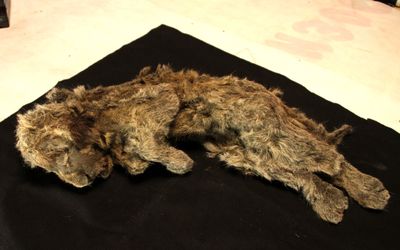
The researchers were able to extract DNA from teeth and bones, but they also had access to soft-tissue specimens from cave lions frozen in permafrost, including two exceptionally well-preserved cubs from Northern Siberia, dated to between 32,000 and 34,000 years ago.
 skull (Photo Love Dalén).jpg "a skull from a subadult cave lion, with partial soft tissue preserver, found in the Siberian permafrost near the Indigirka River and radiocarbon dated 34,000 years before present.")
What did the new study find?
Cave lions may look like a slightly beefier and hairier version of modern lions, but their evolutionary relationship is far more subtle and intertwined than these first impressions suggest.
“For the split between modern lions and cave lions, we are likely looking at a period of time known as the Early Pleistocene. A large number of different species split during this time, but a close analogy could be something like wolves and coyotes,” lead study author David Stanton, a former postdoc in Stockholm and now a Lecturer at Cardiff University in the UK, told IFLScience.
“So in that case, wolves and coyotes are both still around today, and we know that they can interbreed,” he notes.
The Early Pleistocene – when cave lions and modern lions most likely split – was a time when the climate cycled between multiple glacial periods.
David Stanton
And interbreeding is exactly what the DNA evidence shows. Cave lions appear to have intermingled with modern lions across multiple periods of their shared history, most strikingly in periods when there were blips in the global climate.
Colder periods appear to have pushed cave lion populations southward, bringing them down from the northern latitudes into contact with modern lions across Central and Southwest Asia. As closely related mammals tend to do when their ranges overlap, they mated like rabbits.
“The Early Pleistocene – when cave lions and modern lions most likely split – was a time when the climate cycled between multiple glacial periods. So the temperature fluctuated, leading to the ice sheets expanding and contracting over time. This would have led to animals having to change where they live – and depending on what type of climate they were best adapted to – could have led to different animal populations either becoming more isolated, or coming into contact,” explained Stanton.
.jpg "Study co-author Love Dalén measuring cave lion cub.")
The legacy of cave lions lives on
Most of the gene flow appears to be linked to a population of lions that lived in Southwest Asia and a small band of cave lions that ventured south. Though modest in scale, the genetic exchange reveals some deep insights into the movements of the long-gone cave lion.
"The actual amount of cave lion DNA in modern lion genomes and vice versa is very small; less than 5 percent by our estimates. It is also very similar – from an evolutionary point of view, these two species are quite closely related – meaning it is very hard to detect," Stanton explained.
Like many large predators, the cave lion went extinct at the end of the last Ice Age around 13,000 years ago, as the world warmed, habitats shifted, and prey became scarce. On top of those environmental changes, they were likely victims of early human expansion, as our ancestors exploited the changing landscape and hunted with increasing intensity.
Tragically, that same Southwest Asian lion population, with whom cave lions had interbred so extensively, was also hunted to extinction a little over a century ago.
“It feels slightly melancholic that the population of modern lions that likely had the most cave lion DNA in their genome - in South West Asia - were themselves hunted to extinction by humans by the early 20th century,” added Stanton
The study is published in the journal Cell.