Space and Physics
 PUBLISHED


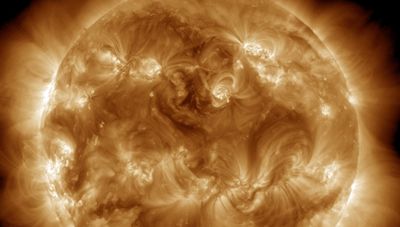


The Sun is having a grand old time at the moment, flinging out plasma, solar flares, and CMEs as it starts to ramp up to the solar maximum. The latest activity saw a sunspot explode in the early hours of this morning, sending out a solar flare and shockwave through the Sun’s atmosphere.
Luckily caught by NASA’s 24/7 Solar Dynamics Observatory, active sunspot AR3213 produced an M3.7 class flare. The resulting shockwave generated a Type II solar radio burst that, according to Spaceweather.com, sent a shock tearing through the Sun’s atmosphere at a speed of 2.9 million kilometers (1.8 million miles) per hour, or put another way, 820 km/s (509.5 miles per second).
The Solar Dynamics Observatory, which has been studying the Sun's solar activity and what drives space weather since 2010, created an ultraviolet movie of the event.

Solar shockwaves are also known as solar tsunamis and are generated by solar flares. This flare has been classed as an M3.7-class. M-class flares are medium-sized, they can cause brief radio blackouts and minor radiation storms.
Sunspots are cooler areas of the Sun caused by magnetic fields that weaken the processes by which heat rises to the Sun's surface. Although the spots themselves emit less energy than surrounding areas, they are associated with flares and coronal mass ejections (CMEs) where plasma bursts into space. When these occur, charged particles stream away from the Sun, and those that head in our direction can be funneled by Earth's magnetic field toward the geomagnetic poles. When they strike the upper atmosphere they can produce breathtaking auroras.

Our Sun has a natural 11-year cycle of activity, measured from minimum (the least activity) to maximum (the most active, with sunspots, flares, and storms) and back to the minimum. Solar Cycle 25, the 25th since reliable records of solar activity began, started in December 2019 and we're set to reach peak activity in 2025.
However, the Sun has already been more active during this solar cycle compared to the previous one. We've definitely had an uptick in sunspots, flares, filaments, and coronal mass ejections and we are still two years away from the expected solar maximum. It's only going to get more exciting from here.

 1
1