Space and Physics
 PUBLISHED


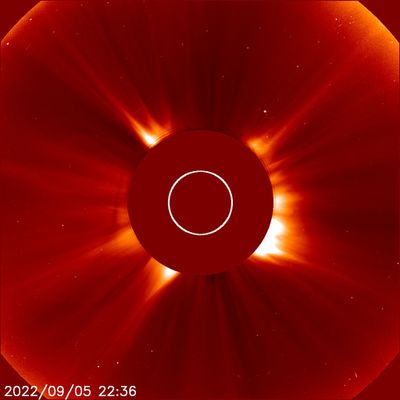


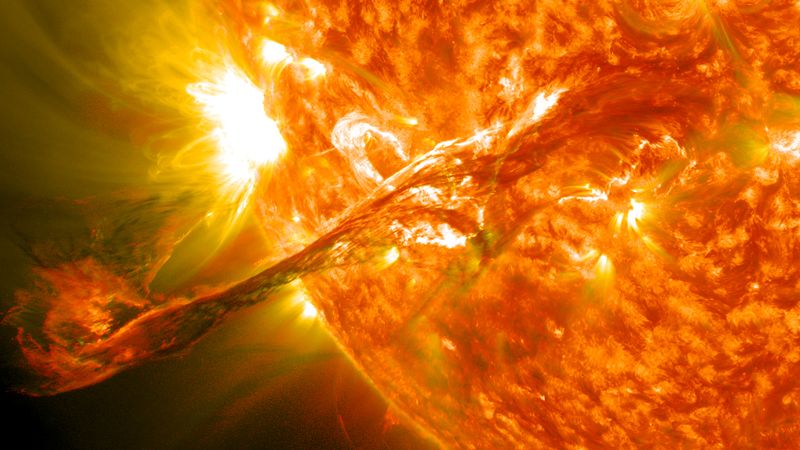
The Sun has been pretty active lately, delighting scientists and amateur astronomers alike. This week, it took it up a level with a massive explosion on its far side that sent out a magnificent full-halo coronal mass ejection (CME), which scientists have described as a “no run-of-the-mill event”. Luckily Earth wasn’t in its way, but Venus was – and got walloped for the second time in less than a week.
It wasn’t just Venus that got walloped. The first CME that hit Venus on September 1 managed to catch the European Space Agency and NASA’s Solar Orbitor as it was about to conduct a flyby. Fortunately, the spacecraft wasn’t affected by the CME. In fact, this means we can study CMEs from the Sun's far side in a way we never have before.
The second, on September 5, was enormous, sending a huge M-2 class flare out into the Solar System.

"This is no run-of-the-mill event. Many science papers will be studying this for years to come," George Ho, a lead investigator of the Energetic Particle Detector instrument onboard Solar Orbitor, told Spaceweather.com.
"I can safely say the Sept. 5th event is one of the largest (if not THE largest) Solar Energetic Particle (SEP) storms that we have seen so far since Solar Orbiter launched in 2020. It is at least an order of magnitude stronger than the radiation storm from last week's CME."
CMEs are what happens when sunspots flare and erupt, flinging out charged particles into space. When they are shot towards Earth, they can be funneled by Earth's magnetic field to the geomagnetic poles, creating beautiful auroras. Strong CMEs can cause strong geomagnetic storms that can impact technology and even cause radio blackouts.
It is likely the huge CME came from the same sunspot that launched the attack on Venus earlier in the week. The active sunspot, AR 3088, popped up in August and since it has transited the far side of the Sun, is bigger and angrier than ever. The Sun's rotation will bring it back around to face us in just over a week, so we may not be out of the firing line yet.