Space and Physics
 PUBLISHED
 1
1




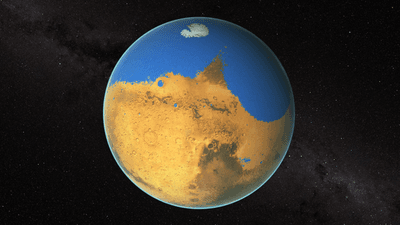


Evidence of free-flowing water in Mars’s past has been mounting for a long time. River deltas, water-altered minerals, and more have painted a picture of a wet world long ago. What remains a mystery is its climate. Was it cold and wet or mild and wet? Lots of ice or a stable ocean? New evidence suggests that about 3 billion years ago, there was a hemisphere-spanning ocean in the north of Mars.
This comes from a team studying Valles Marineris, the largest − though not the longest − canyon system in the Solar System. It is more than 4,000 kilometers (2,500 miles) long and 200 kilometers (120 miles) wide.
The researchers were investigating geological structures in the southeast of an area called Coprates Chasma, which is believed to have once hosted a deep lake. The features that most interested the team were the canyon's scarp-fronted deposits (SFDs), which indicate the presence of inward-flowing rivers. All the SFDs were found at roughly the same altitude, between -3,750 and -3,650 meters (-12,303 and -11,975 feet).
The finding suggests a consistent water level within the canyon, and that the water was about 1 kilometer (3,280 feet) deep at points. If this was the case, then the planet’s northern hemisphere, made of lowlands that have a lower elevation than the inside of the canyon, must have been flooded too.
"With our study, we were able to provide evidence for the deepest and largest former ocean on Mars to date – an ocean that stretched across the northern hemisphere of the planet," lead author Ignatius Argadestya, a graduate researcher from the University of Bern, said in a statement.
The presence of a large ocean suggests that the now Red Planet might have once had habitable conditions. though whether it really did sustain life remains a mystery − one that might continue for a while, since the US has just canceled its Mars Sample Return mission.
"We know Mars as a dry, red planet. However, our results show that it was a blue planet in the past, similar to Earth. This finding also shows that water is precious on a planet and could possibly disappear at some point," emphasized Argadestya.
"This project is particularly exciting for us researchers from the field of geology because it allows us to transfer concepts that we have developed from studies on Earth to other planets such as Mars," said Fritz Schlunegger, Professor of Exogenous Geology at the University of Bern. "We used a sedimentological approach for this study, meaning we compared depositional environments between Earth and Mars."
The team now plans to study the mineralogy of the SFDs and see what they are made of. These analyses, just like the one in this study, will be done from orbit using the European Space Agency's ExoMars Trace Gas Orbiter, as well as ESA’s Mars Express and NASA’s Mars Reconnaissance Orbiter.
"Now that we know that Mars was a blue planet, we also want to know what kind of weathering took place there," concludes Argadestya.
The study is published in the journal npj Space Exploration.