Space and Physics
 PUBLISHED



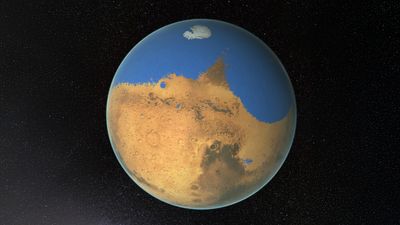


Mars is a planet divided in two. The southern hemisphere is made of highlands, marked with many large craters, volcanoes, and canyons. The northern hemisphere is instead marked by smooth lowlands. The Red Planet had a wet past and it is believed to have had an ocean covering the northern hemisphere. New data from the Chinese rover Zhurong agrees.
Evidence collected both in space and on the ground revealed more evidence of rocks and terrain that were likely altered by water. The team cannot be certain yet whether it was a marine environment, flowing water, or ice that altered these rocks, but water was involved. Zhurong had already found evidence of some weird water-based shenanigans when it discovered peculiar buried polygonal structures.
Zhurong landed on Utopia Planitia on May 14, 2021 and worked on the surface of Mars for just short of a year. It became inactive due to a sandstorm and the Martian winter, with China announcing its demise almost a year after it stopped working.
Utopia Planitia was considered, for a time, the possible nearshore zone of the ocean, and this is their reasoning. The work suggests that the landing area of Zhurong can be divided in two. One part has water-related features that are not dependent on the amount of water that is present; this is to the south.
To the north, there is an area that also has water-related features, but from orbit it looks like those features required a larger presence of water to have formed. In the scenario researchers envisioned, a large ocean was present around 3.65 to 3.68 billion years ago. It likely had a frozen surface. Over the following 230 million years the ocean retreated, until it disappeared completely.
Zhurong landed in the southern part of the nearshore, the one without the abundant amount of water. It confirmed the presence of minerals that were indeed created in water or ice interactions, but it couldn’t for certain say that those rocks were altered by an ocean or by another water event taking place eons ago.
Across the Red Planet, rovers and orbiters have found a wealth of evidence of rivers, lakes, and even of this possible northern ocean. These mission are building a coherent picture of what Mars had been like but there are still missing pieces of the puzzle. Mars might have been hot and wet or cold and wet, or both for a time.
A mission further north from the Zhurong landing site might find more irrefutable evidence that there was an ocean on Mars, and what that ocean might have been like.
The study is published in the journal Scientific Reports.