Space and Physics
 PUBLISHED


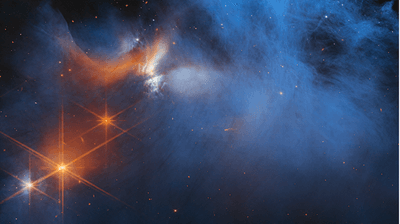


Peering into the Chamaeleon I, a part of space known as a nursery for stars, the JWST has detected the spectrum of ice with water molecules only partially bound inside. Known as “dangling OH”, this indicates the presence of water molecules that have not bonded to all their neighbors, as can occur when ice is impure or porous.
Urban folklore has it that the Inuit language has dozens of names for ice and snow, reflecting their ubiquity in the lives of its speakers. The claim may not be true, but scientists have categorized a great many different types of water ice, so varied are the ways in which the curious H2O molecule can arrange itself. Signatures of several of these have been found beyond Earth.
One ice type occurs when ice forms rough surfaces at a very small scale and some molecules bond with fewer than the maximum four neighbors, known as “dangling OH” because a potential bond is left hanging. Dangling OH occurs most often when water sits on the surface of ice made from a mix of H2O and other molecules. This sort of ice has been made in laboratories, allowing astronomers to observe the spectrum produced when light shines through it. Since the 1990s, the same spectrum has been sought with telescopes, but it took the JWST to find it.
It was always going to be hard to find the signal from dangling OH ice because the distinctive parts of the spectrum it produces are largely blocked by our atmosphere. Pre-JWST space telescopes operating in the infrared apparently lacked the sensitivity and resolution to find examples.
Nevertheless, astronomers persisted because the presence of dangling OH ice indicates highly porous “fluffy” grains of ice, which are thought to play a key part in the process of planetary formation. Spectra taken by the JWST of Chamaeleon I reveal absorption lines at wavelengths of 2.703 and 2.753 μm - previously identified signatures of dangling OH, at several locations.

The team behind the discovery suspects the 2.703 μm line is produced by droplets on grains of almost pure water ice, while the 2.753 μm comes from ice with considerable impurities, probably frozen carbon monoxide or carbon dioxide.
“The detection of the water dangling bond feature in the ice mantles demonstrates the importance of laboratory astrophysics to interpret JWST data”, said Dr Barbara Michela Giuliano of the Max Plack Institute in a statement. “Detailed information on the physical properties of the observed ices still requires extensive support from the laboratory to disentangle the spectral properties observed within dense regions of the interstellar medium and protoplanetary disks.”
“The high sensitivity of JWST, together with impressive advancements in laboratory astrophysics, is finally allowing us to study in detail the physical structure and chemical composition of interstellar ices,” said Professor Paola Caselli. “This is crucial to provide stringent constraints on chemical/dynamical modeling, needed to reconstruct our astrochemical history, from interstellar clouds to protoplanetary disks to stellar systems like our own. It is exciting to be part of this endeavor.”
Fluffy ice grains allow a greater range of molecules to attach to their surface, and therefore more complex chemistry to occur long before any planet has formed. This is consistent with the discovery of spectra from chemicals that have sometimes surprised in their complexity. By confirming the presence of dangling OH, and therefore the fluffy grains in Chamaeleon I, Giuliano, Caselli, and co-authors have provided a crucial feature to be incorporated into models of the evolution of protoplanetary disks.
Having made the breakthrough, the authors hope to go further, exploring patterns of where dangling OH is and is not observed, as well as tracking different types from subtle differences in wavelength.
The study is published in the journal Nature Astronomy.