Space and Physics
 PUBLISHED
 1
1



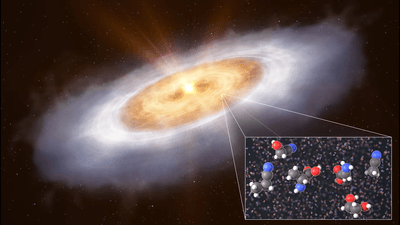


Astronomers report the discovery of 17 different complex organic molecules around protostar V883 Orionis. They also report the first tentative detection of ethylene glycol and glycolonitrile, which are precursors to crucial building blocks of life such as the amino acids glycine and alanine, as well as the nucleobase adenine found in both DNA and RNA. This doesn't mean signs of life have been discovered, but it does go towards evidence that the building blocks of life could form throughout the universe under the right circumstances.
Complex organic molecules, aka COMs, have been found in a wide variety of environments in space, including the giant molecular clouds that give birth to stars. Star formation, though, is a very energetic process, so it was not clear if these molecules could survive the protostar phase and be incorporated into planetary material from the get-go.
The team, led by Abubakar Fadul from the Max Planck Institute for Astronomy, used the Atacama Large Millimeter Array (ALMA) to study V883 Orionis and detect the intriguing molecules. The team is planning to collect higher resolution data to better understand the detection, confirming the tentative signatures, and maybe discovering even more COMs.
If these molecules could exist in such an environment and survive the star formation, it would give us a strong hint that those molecules could incorporate into planets and eventually make a favorable environment for life to emerge.
Abubakar Fadul
“Finding these molecules in such an environment is really exciting because this is the last stage after the star is formed but before the planet is forming,” Fadul told IFLScience.
“If these molecules could exist in such an environment and survive during the star formation, it would really give us a strong hint that those molecules eventually could incorporate into planets and eventually could make a favorable environment for life to emerge in the future.”
If we want to answer how life came to be, we need to know where the molecules that are fundamental for life on Earth form. There have been precursors found in interstellar space, in the tails of comets, and in asteroid samples. It’s clear that interesting chemistry is happening in space, but we do not know if these molecules are formed time and time again, or if they can withstand the changes the planetary system experiences.
“We know that during the star formation, there is a harsh environment. So we don't know if those molecules really survive this harsh environment or form within the disc,” Fadul told IFLScience. “[Where the molecules formed] is one of the fascinating questions that we're still trying to find an answer to.”
V883 Orioni is about one-third heavier than our Sun but a lot younger at just 500,000 years old. Studying this and other protoplanetary disks to understand their chemical composition could help us understand how we and all living beings on Earth got here.
The results are published in three papers in The Astrophysical Journal Letters, The Astronomical Journal, and The Astrophysical Journal.