Space and Physics
 PUBLISHED





In the year 1181, a new star appeared in the sky in the constellation of Cassiopeia. It was a “guest star”, what we now call a supernova. For 180 days it was bright enough to be seen before disappearing, lost for centuries. When it was rediscovered in 2021, astronomers were able to work out what happened and now thanks to new research it is clear that it was something quite unique.
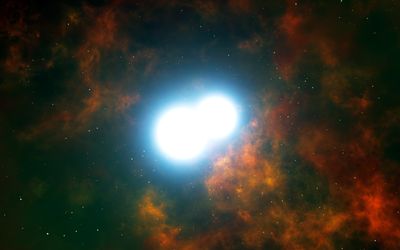
The supernova is a Type Iax (pronounced One-a-x) which involves two white dwarfs slamming into each other. A white dwarf is the exposed core of a star like the Sun having reached the end of its life. The collision should have annihilated the two, turning everything into energy but instead, it results in a new peculiar white dwarf, spinning very fast on its axis.

The team conducted several observations of the region Pa 30 – what the supernova remnant was called before getting the new name of SNR 1181. They found two shock regions around the object, an old one following the supernova and a more recent one.
White dwarfs that form as a result of a Type Iax supernova are expected to release stellar wind, but the team couldn’t work out the source of the more recent shocks. Computer simulation of the object suggests that over the last 20 or 30 years, the stellar wind has picked up again. Possibly, it’s due to material falling on the white dwarf increasing its temperature and density beyond the threshold needed to restart burning.
“If the wind had started blowing immediately after SNR 1181’s formation, we couldn’t reproduce the observed size of the inner shock region. However, by treating the wind’s onset time as variable, we succeeded in explaining all of the observed features of SNR 1181 accurately and unraveling the mysterious properties of this high-speed wind. We were also able to simultaneously track the time evolution of each shock region, using numerical calculations,” lead author Takatoshi Ko, a doctoral student from the Department of Astronomy at the University of Tokyo, explained in a statement.
The appearance of the supernova is reported in a record of the Genpei War in Japan (1180-85) called the Azuma Kagami. The war led to the establishment of the shogunate and this text chronicled the important events but also the day-to-day occurrences including the appearance of a new star in the constellation of Cassiopeia.
“There are many accounts of this temporary guest star in historical records from Japan, China, and Korea. At its peak, the star’s brightness was comparable to Saturn’s. It remained visible to the naked eye for about 180 days, until it gradually dimmed out of sight. The remnant of the SN 1181 explosion is now very old, so it is dark and difficult to find,” explained Ko.
The team will now conduct more observation of SNR 1181 with different types of telescopes to better understand its behavior and ideally confirm what the simulation suggests: that this dead star is having a resurgence.
A paper describing the result is published in The Astrophysical Journal.