Space and Physics
 PUBLISHED




In 2016, NASA launched the Origins, Spectral Interpretation, Resource Identification, and Security-Regolith Explorer (OSIRIS-REx) probe, which famously touched down on asteroid Bennu in 2020, before returning that sample back to Earth for analysis.
While that mission was certainly successful, it was not NASA's first rodeo. The first samples returned from beyond the Moon were collected by the Stardust mission, launched on February 7, 1999.
In 1990, NASA began its Discovery Program. This was a series of lower-cost missions, designed to explore various parts of the Solar System. These missions, each focused on very specific scientific goals, were pretty cool. The first, NEAR Shoemaker, saw a spacecraft orbit and then make a soft landing on asteroid 433 Eros, the first time both maneuvers were achieved. The second, a little better-known, landed NASA's Mars Pathfinder rover on the Red Planet.
Stardust was the fourth of these missions, and it was a very cool one. It was the first US mission whose sole purpose was to study a comet, and its overall goal was to collect samples from the coma of Comet Wild 2, as well as other interstellar particles, before returning these particles to Earth. The craft itself was simple in design, for a spacecraft, of course.
"Stardust was comprised of a 560-pound (254-kilogram) spacecraft that included a 100-pound (45.7-kilogram) sample return capsule shaped like a blunt-nosed cone. The spacecraft had five major components: a heat shield, backshell, sample canister, parachute system, and avionics," NASA explains.
"The samples were to be collected using a low-density microporous silica-based substance known as aerogel, attached to panels on the spacecraft to 'soft-catch' and preserve the cometary materials."
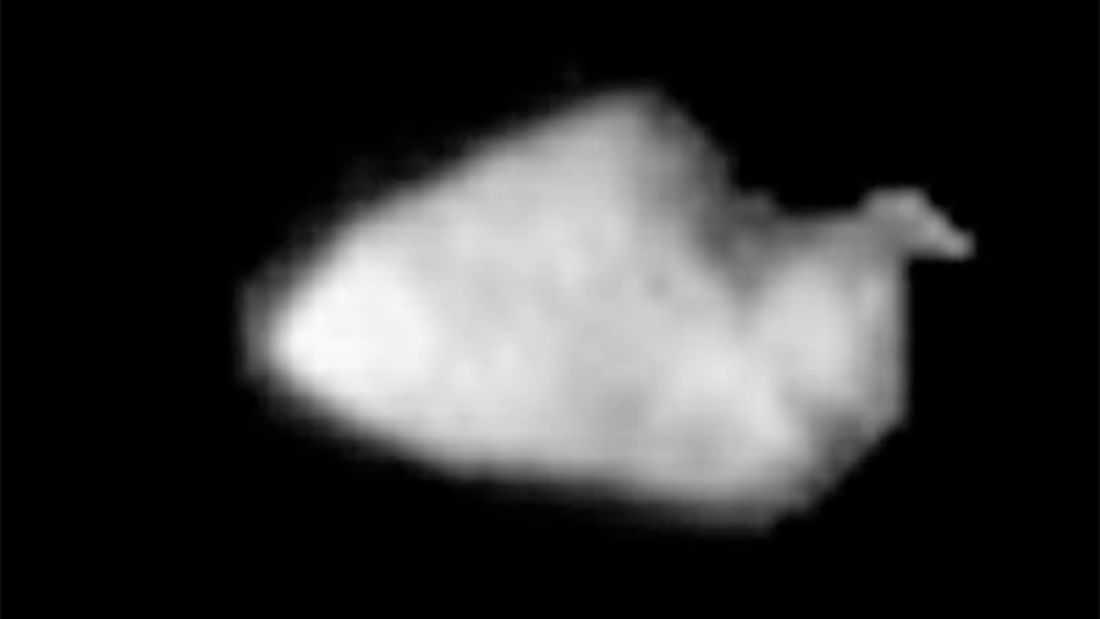
In 1999, the spacecraft was launched on a heliocentric orbit, which would bring it back around to Earth a year later for a gravity assist. From here, it did not go to Comet Wild 2 directly, but first headed to the minor planet Annefrank, of course named for Anne Frank, where it imaged the object and collected dust samples, ahead of its primary mission.
"Stardust flew within about 3,300 kilometers (2,050 miles) of the asteroid as a rehearsal for the spacecraft's encounter with its primary target, comet Wild 2, in January 2004," NASA explained. "The camera's resolution was sufficient to show that Annefrank is about 8 kilometers (5 miles) in length, twice the predicted size from Earth-based observations."
A year later, the spacecraft arrived at Comet Wild 2, opening its dust collector on December 24, 2003. On its closest approach on January 2, 2004, the craft was just 250 kilometers (155 miles) from the comet. Around six hours after its closest approach, the spacecraft closed its collector and stowed the samples for its return to Earth.
On January 15, 2006, the sample return capsule separated from the main spacecraft and returned to Earth, landing via parachute in a landing zone at the US Air Force Test and Training Range in Utah.
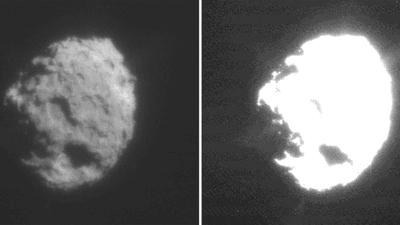
But the spacecraft itself wasn't done yet. As the mission had gone on, NASA had set a new target for the Stardust. Now rebranded as Stardust/NExT, the spacecraft headed to Comet Tempel 1 (or 9P/Tempel). This comet had been the target of another Discovery mission; NASA's Deep Impact had slammed a small probe into its surface. Stardust/NExT was able to confirm the impact site, gaining a little extra data for NASA to analyze.
"We see a crater with a small mound in the center, and it appears that some of the ejecta went up and came right back down," Pete Schultz of Brown University, Providence, R.I, said in a NASA statement at the time. "This tells us this cometary nucleus is fragile and weak based on how subdued the crater is we see today."
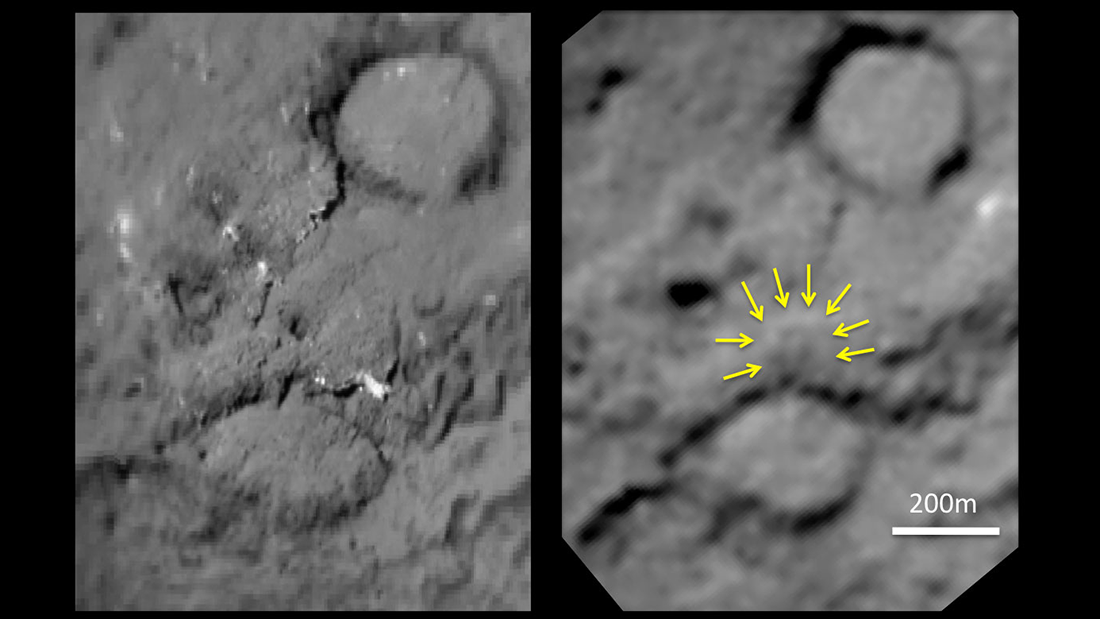
This marked another first in spaceflight history; the first time humanity's probes had revisited a comet. But it was the final part of the mission for Stardust. On March 24, 2011, the spacecraft expelled its final propellant and returned its final message to the Earth.
"The analysis of the samples returned by the spacecraft showed the presence of a wide range of organic compounds," NASA said. "In August 2014, NASA announced that seven rare, microscopic interstellar dust particles dating from the very origins of the Solar System were among the samples collected by Stardust."