Space and Physics
 PUBLISHED
 3
3


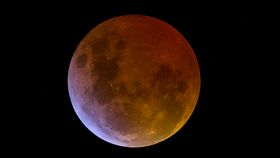


This week the Sun, Earth, and Moon will come together in near-perfect alignment, creating a partial lunar eclipse as Earth’s shadow falls on the Moon. It may not be as showy as a total eclipse, but it will be the longest partial eclipse in 580 years, the likes of which won’t be seen again for another 648 years.
Occurring the night of November 18-19, the partial eclipse will peak at 4:03 am ET, when 97 percent of the Moon will be covered. The eclipse will be visible for three hours on either side of this to anyone in North and South America, Australia, the Pacific region, and parts of Europe and eastern Asia. Although not totally covered, with just a sliver of Moon visibly reflecting the Sun's light, the rest of the Moon will appear a reddy-brown just like a total lunar eclipse.
Partial lunar eclipses occur went the Earth moves in between the Sun and a full Moon but they don't quite line up perfectly. A small part of the Moon's surface is covered by the inner (darkest) part of Earth's shadow, the umbra, while the rest of the Moon is covered by the outer part of Earth's shadow, the penumbra. In this case, the umbral eclipse will last for 3 hours and 28 minutes — the longest of the century — while the penumbral eclipse, when the Moon passes through both inner and outer parts of Earth shadow, will last for a whopping 6 hours and 1 minute.
This will be the longest partial lunar eclipse since February 18, 1440 — around the time Machu Picchu was being built — and Earth won’t see another of this duration until February 8, 2669, so you won't exactly be able to tell your grandkids you saw it, but you’ll know.
Luckily, you don't need any specialist equipment to look at a lunar eclipse. Unlike a solar eclipse, it's totally safe to look at without protective eyewear or filters, should you want to use a telescope or binoculars.
As usual, Time and Date will be able to tell you the exact timings of the umbral and penumbral eclipses based on your location. If the sky is too cloudy or you don't fancy sitting out in the cold, the Virtual Telescope Project will be live streaming it, as will Time and Date.
And if you miss all this completely, don't worry, there will be a total lunar eclipse to look forward to in May 2022.