Space and Physics
 PUBLISHED
 2
2


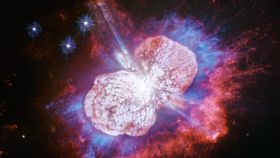


Eta Carinae is among the most remarkable stars we can see. Now, the Hubble Space Telescope has imaged it as never before, studying the ultraviolet light it is emitting at unprecedented resolution, and providing the extraordinary image above.
The brand new image reveals not only details never seen before, but something that surprised astronomers: magnesium gas (shown in blue) where they were expecting just empty space.
The largest star in the Eta Carinae system is so massive it forced a rethink of the upper boundaries of how heavy a star could be. Since the more mass a star has, the shorter its lifespan, that also means it won't last long, at least by astronomical standards. Given its size, it will probably end its life in at least a supernovae explosion, or an even more powerful hypernova. At 7,500 light-years away, it's distant enough to pose no threat, but close enough to provide a fabulous "fireworks" show, that is still ongoing.

While we wait, Eta Carinae teases us. In the mid 19th century it became the second brightest star in the sky during the so-called Great Eruption. Unfortunately, Eta Carinae is so far south that northern hemisphere telescopes can barely see it. Back then the southern hemisphere lagged in astronomical equipment, so our observations were limited.
Today, however, Hubble covers the whole sky, allowing it to view the Homunculus Nebula, the two expanding clouds of gas thrown off in the Great Eruption. For this image Hubble used its Wide Field Camera 3 to map magnesium and nitrogen gas around the Nebula. The magnesium glows in ultraviolet, which has been shown as blue in this image so as to be visible to our eyes, while the nitrogen is in red.
The Great Eruption was unprecedented in size, but not the first time Eta Carinae had expelled part of itself. As the faster moving molecules from the Great Eruption catch up with material that was thrown off beforehand shockwaves are generated, heating both. By sensing the temperature of the magnesium, Hubble revealed its distribution, which was not always where astronomers expected based on previous studies in visible and infrared light.
“We’ve discovered a large amount of warm gas that was ejected in the Great Eruption but hasn’t yet collided with the other material surrounding Eta Carinae,” Dr Nathan Smith of the University of Arizona said in a statement. “Most of the emission is located where we expected to find an empty cavity. This extra material is fast, and it ‘ups the ante’ in terms of the total energy of an already powerful stellar blast.”
It is hoped that by learning about this pre-eruption ejecta we will come to understand what caused the explosion, and when we'll get to see the main event. Eta Carinae is known to be two stars, but one theory holds it was once a triple system, with the Great Eruption triggered by the largest star swallowing the smallest.
NASA, ESA, N. Smith (University of Arizona, Tucson), and J. Morse (BoldlyGo Institute, New York), L. Calcada, Risinger (skysurvey.org)