Space and Physics
 PUBLISHED


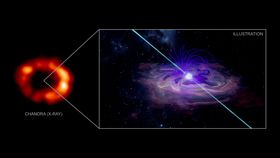


On February 24, 1987, astronomers observed the closest supernova to Earth in 400 years. SN 1987A, as it was called, took place in the Large Magellanic Cloud, one of the galactic companions of the Milky Way. It became one of the most studied objects in the sky, and a big mystery ensued for the last 34 years – and it might have been finally solved.
Astronomers didn’t know what the supernova had left behind. Observations from the supernova suggest a pulsating neutron star (pulsar) was likely the remnant of this cosmic explosion, but no evidence of this was able to be found until recently. These are reported in The Astrophysical Journal Letters.
Observations from NASA's Chandra X-ray Observatory, NASA's Nuclear Spectroscopic Telescope Array (NuSTAR), and the ground-based Atacama Large Millimeter Array (ALMA) paint a very interesting picture. While they didn’t see the pulsar itself, they found evidence for a pulsar wind nebula.
"For 34 years, astronomers have been sifting through the stellar debris of SN 1987A to find the neutron star we expect to be there," lead author Emanuele Greco, of the University of Palermo in Italy, said in a statement. "There have been lots of hints that have turned out to be dead ends, but we think our latest results could be different."
The team believes that the core of SN 1987A is surrounded by gas and dust. This material blocks the pulsar from being visible, absorbing the X-ray photons that the pulsar is expected to be producing – hence why so far, the pulsar has not been forthcoming.
The combined power of the three observatories provides evidence that the emission seen so far is consistent with what a pulsar shrouded in gas and dust would look like. There are alternative explanations, but they are a lot less likely based on what we know.
The models used have also an important prediction: This veil of dust is dissipating. Soon, we might see the pulsar directly.
"Being able to watch a pulsar essentially since its birth would be unprecedented," added study co-author Salvatore Orlando of the Palermo Astronomical Observatory. "It might be a once-in-a-lifetime opportunity to study the development of a baby pulsar."
According to the work, the pulsar will become visible over the next decade. At 168,000 light-years from Earth, it wouldn’t be the closest, but it would certainly be the youngest yet observed.