Space and Physics
 PUBLISHED
 1
1



Observations from two separate spacecraft have confirmed the presence of methane on Mars, indicating there may have been life on the Red Planet at one point and highlighting the possibility that the planet may be able to support human life.
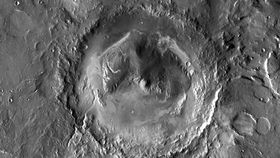
Writing in Nature Geoscience, researchers believe that an ice sheet east of Gale Crater – believed to be a dried-up lake – is the most likely source of methane on the planet.
"This is very exciting and largely unexpected," Marco Giuranna, from Rome's National Astrophysics Institute, told AFP.
"Two completely independent lines of investigation pointed to the same general area of the most likely source for the methane."
In June 2013, the Mars Express probe operated by the European Space Agency measured 15.5 parts per billion in the atmosphere above the Gale Crater. The presence of methane in the area was then confirmed by NASA’s Curiosity rover within 24 hours. To test whether the contentious findings were legitimate, researchers divided the region around the crater into 250 by 250 square kilometer grids and ran a million computer-modeled emissions scenarios for each section. Meanwhile, another team studied images of the surface of Mars to compare it with similar features on Earth where methane is released. They found the most likely culprit was frozen methane beneath a rock formation.
Methane is a naturally occurring gas that is the byproduct of organic processes, like animals digesting food or humans farting. Though it is a major indication of life on Earth, it doesn’t necessarily indicate evidence of something similar on Mars – though its discovery is promising.
"Methane is important because it could be an indicator of microbial life. But life is not required to explain these detections because methane can be produced by abiotic processes,” explained Giuranna.
"Though not a direct biosignature of life, methane can add to the habitability of martian settings, as certain types of microbes can use methane as a source of carbon and energy.”
Just last year, researchers with the National Institute of Astrophysics in Rome reported finding a vast reservoir of water resembling a subglacial lake on Earth below the south pole on Mars.