


 Space and Physics
 PUBLISHED


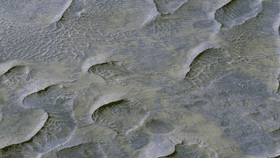


Billions of years ago, Mars turned from a wet world rich in water to the dry frigid desert we know today. Signatures of its past, however, can still be seen in ancient river deltas, lakes, and even the impression of dunes created by lava.
Now researchers report the discovery of more fossilized dunes created much more recently in Mars's geological past. These peculiar formations have been found in Valles Marineris, one of the largest canyons in the Solar System. Published in the Journal of Geophysical Research Planets, these dune impressions formed about 1 billion years ago, and the team notes how similar they look to today’s dunes.
“We identified and mapped extensive dune fields in the canyons of Valles Marineris which show clear evidence for lithification and burial. This level of preservation is rare for terrestrial sand dunes due to ongoing erosion and tectonics,” lead author Matt Chojnacki from the Planetary Science Institute said in a statement.
“Based on the dune deposit’s relationships to other geologic units and modern erosion rates we estimate these to be roughly a billion years old. Because of the duneforms’ size and spatial arrangements, which are not that much different to modern equivalents, we suggest that the climate and atmospheric pressure to have been similar to that of contemporary Mars.”

Earth also has dunes that are lithified, basically turned to stone. Thanks to some fortunate conditions, their shape was preserved for millions of years in rocks. But Earth is shaped by flowing water, volcanos, quakes, rain, and wind. These ancient dunes are often eroded to a shadow of their former self.
Mars, however, has about 1 percent of the density of Earth’s atmosphere, no tectonics, and no water cycle, so the erosion dunes might experience is dramatically different compared to our own planet. And given this difference, we can learn much more about Mars from these relics of a bygone age.
“The ancient dune fields found within Valles Marineris, with their complex variety of landform shapes, degree of preservation, and context, reveal the richness of regional geology,” Chojnacki added. “These results inform us that wind-driven sand transport, deposition, and lithification have occurred throughout much of Mars’ recent history and illustrate how landscape evolution there greatly differs compared to that of Earth.”
The dunes of Mars have been the focus of many observations both by rovers and from orbit. You can even see them move.



 1
1