Space and Physics
 PUBLISHED
 1
1




NASA launched the Mars Reconnaissance Orbiter (MRO) on August 12, 2005, and thanks to its extremely sharp cameras it has captured and sent back some incredible views of Mars. To mark its 15th anniversary the space agency has re-released some of the most evocative and scientifically important photos collected by MRO.
The images were snapped by the orbiter's three cameras. MARCI (Mars Color Imager) has a fisheye lens and delivers a daily global view of the Red Planet. This is particularly useful in studying how global dust-storms evolve, including the one that led to the demise of poor Opportunity.
Second is CTX or the Context Camera, which provides 30-kilometer-wide (19-miles-wide) black-and-white terrain images that are used for context for HiRISE (High-Resolution Imaging Science Experiment), the camera capable of truly zooming in on the surface.

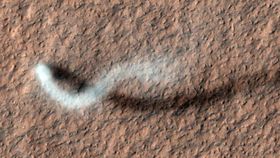
Among these beautiful portraits of Mars, there are many transient phenomena that MRO has also captured, such as a stunning landslide, a glimpse of the slow processes that alter the Martian surface. Another incredible image is a very tall dust devil, stretching about 800 meters (half a mile).
Among the transient events that have been most discussed and debated, were the famous slope lineae, which were discovered by Lujendra Ojha, who was then an undergraduate at the University of Arizona, which operates the HiRISE camera.

"Sometimes you're just looking at the right place at the right time," Ojha, who is now a professor at Rutgers University, said in a statement. "I was completely baffled when I first spotted this because I was just a student at the time, I wasn't even in a planetary program."
The lineae were first believed to be briny flowing water on Mars, but after follow-up observations are now thought to be formed by the flow of darker sand on light soil.
HiRISE is so good that it has been capable of spotting golf-cart-sized rover Curiosity from orbit, even catching the tracks the rover left in its exploration of Gale Crater’s Mount Sharp.

CTX has also detected over 800 new impact craters. Mars's atmosphere is just 1 percent as dense as Earth's, which means larger meteors make it through to collide with the surface. This crater is approximately 30 meters (100 feet), and when whatever hit it landed, it threw ejecta up to 15 kilometers (9.3 miles) away.

But its cameras do not just look at Mars. The spacecraft also images the planet’s major moon Phobos and has even looked back at our own corner of the universe, sending us a lovely portrait of Earth and Moon.
We wish MRO many more anniversaries!