Space and Physics
 PUBLISHED
 3
3


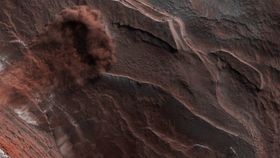


NASA’s Mars Recoinnosance Orbiter (MRO) managed to catch a very cool event on camera near the North Pole of Mars. The spacecraft captured an avalanche raising a big red dust cloud in May this year using its incredible HiRISE (High-Resolution Imaging Science Experiment) camera.
What we are seeing here is the aftermath of loose ice blocks tumbling down a 500-meter (1,640-foot) cliff face, kicking up dust from the thawing terrain underneath. The region is just 370 kilometers (230 miles) from the Martian North Pole.
“Every spring the sun shines on the side of the stack of layers at the North Pole of Mars known as the north polar layered deposits. The warmth destabilizes the ice and blocks break loose,” Candy Hansen, from the University of Arizona, explains on the HiRISE website.
The image was snapped when MRO was just 318.2 kilometers (197.8 miles) in altitude and it has a resolution of 32 centimeters (about a foot) per pixel. Objects less than a meter (about 3 feet) are resolved in this image. The image itself is 1 kilometer (0.6 miles) across.
While capturing an avalanche is an extraordinary and serendipitous event to observe, the thawing of the polar cap is perfectly normal. Mars's seasons last twice as long as their counterparts on Earth and since March, the Red Planet's northern hemisphere has been enjoying its springtime. Spring, however, will be coming to an end soon with the summer solstice happening on October 8.
Mars is the most studied planet in the Solar System, other than Earth. Thanks to our many robotic observers we have been able to further our understanding of its complexity over the many decades of exploration. Despite this, it continues to surprise us, especially when we have a chance to capture something unique like this avalanche.