


 Space and Physics
 PUBLISHED


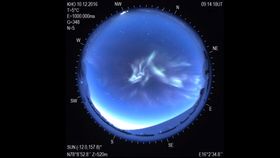


Last summer, Jennifer Briggs, a physics student at Pepperdine University, was interning at NASA when she discovered a brand-new interaction in Earth’s magnetosphere that produced a short-lived aurora reminding Briggs of a seashell.
The auroral seashell is twisty, evidence of a significant disturbance in Earth’s magnetic field. Briggs worked with NASA scientists David Sibeck, Marcos Silveira, and her mentor Gerard Fasel to understand its cause. Usually, these events are associated with eruptions from the Sun, but not this one.
To gain more insight, Briggs used data from NASA’s Magnetospheric Multiscale mission or MMS. The MMS spacecraft was at the right place at the right time to show that the magnetosphere was severely compressed. The aurora was caused by something squeezing the magnetosphere by about 25,000 kilometers (15,500 miles) in 1 minute and 45 seconds.
“You can imagine someone punching Earth’s magnetic field,” Briggs said. “There was a massive, but localized compression,” Briggs said in a statement.
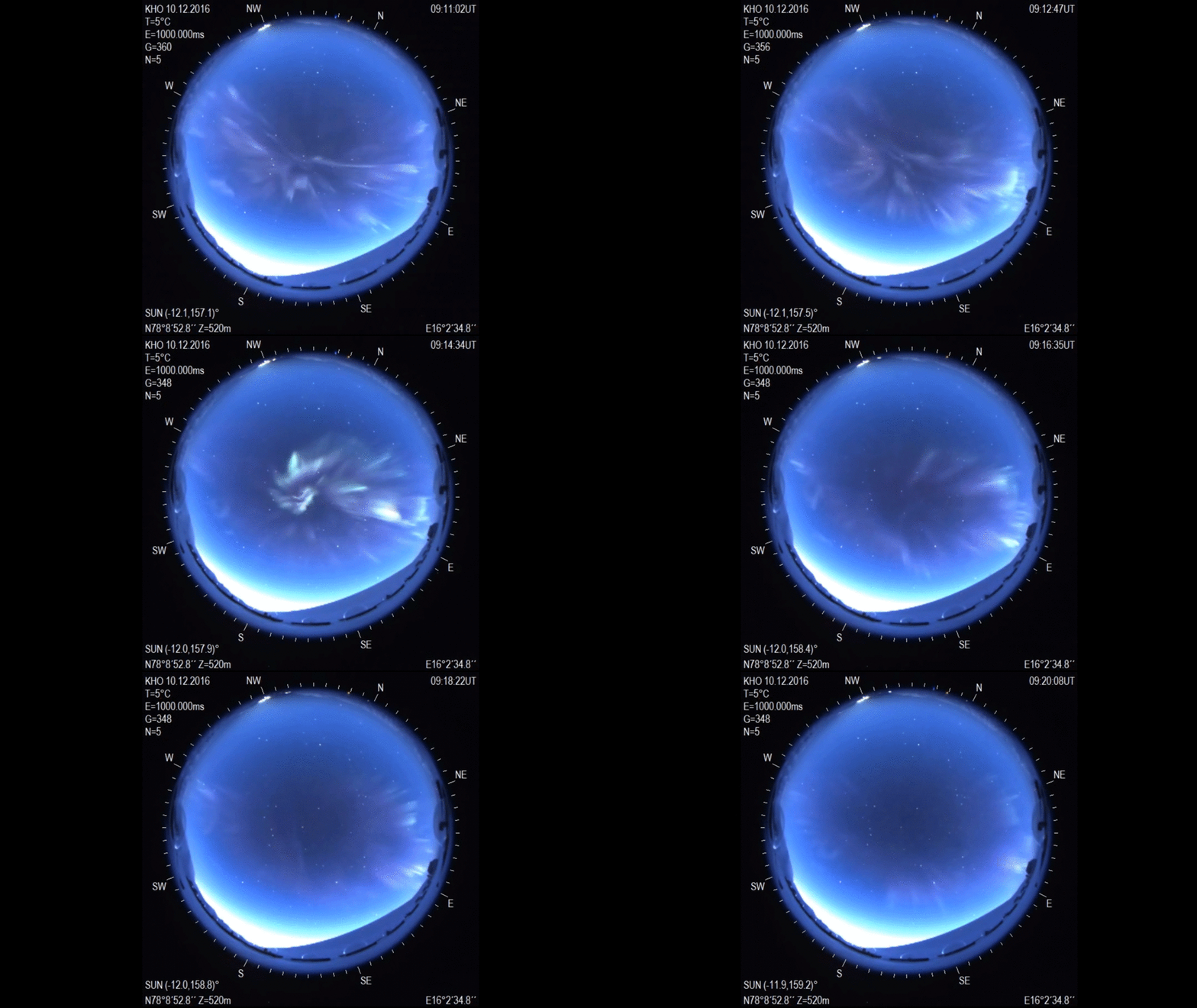
This transient phenomenon is believed to be the first example of a “foreshock generated localized compression.” The foreshock is the region just outside the magnetospheres, where the electrically charged particles of the solar wind first come into contact with the Earth’s magnetic field. The region is turbulent, and such turbulences can result in dramatic events like this.
The magnetosphere is the region of space where the influence of our planet’s magnetic field strongly interacts with the charged particles present in interplanetary space. While on the surface, the Earth’s magnetic field is a dipole (just like a regular bar magnet), as it extends into space, it becomes misshapen under the effect of the solar wind. The side facing away from the Sun extends further away than the Sun-facing side, which is about 65,000 kilometers (40,000 miles) from the planet's surface.
Briggs and her team combined many sets of observations to arrive at these conclusions, which would not have been possible without the student catching the unusual configuration. Their work was presented last month at the American Geophysical Union meeting in San Francisco.


