Space and Physics
 PUBLISHED
 14
14



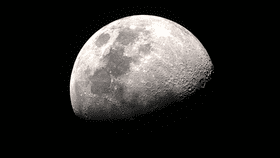


Next week, Roland Emmerich's Moonfall opens in theaters around the world. The latest disaster movie from the director of Independence Day, The Day After Tomorrow, and 2012 will see a team of unlikely heroes tasked with saving the world after the Moon is knocked off its orbit by some mysterious force, sending it potentially crashing towards Earth — with all the consequences that that brings.
NASA Moon, one of the space agency's many official Twitter accounts, took to the social media platform to clarify that our natural satellite is in fact in a very stable orbit and there is no risk of it falling on our heads. "Here are a few reasons why we’re grateful the Moon is stable in its orbit (no offense @MoonfallFilm)," they wrote.
Tagging the official Moonfall account led to a rather good-natured "Twitter spat", with back and forth between the movie and NASA's other accounts that are influenced by the Moon, such as NASA Earth and NASA Ocean, jumping in for support.
The good thing about it is all the science we got out of it. They highlight how the Moon influences the length of the day on Earth and how it affects the tides, crucial for so many living organisms.
The tidal interactions between Earth and the Moon are actually pushing the satellite further away from our planet, not closer. The Moon was created by the debris launched into orbit when a world the size of Mars hit Earth. The Moon actually recedes from us at a rate of 3.8 centimeters (1.5 inches) per year, but this speed has not been constant since its formation.
But let’s take the premise of the movie more seriously for a second. What would it take to bring down the Moon? Well, a lot of energy to start with. Gravity is a complicated beast but we can use the simplified approach that Isaac Newton came up with.
If you throw an apple, it would fall after a short while. But if you were really high, you could throw the apple fast enough and far enough that while falling, it would miss the ground. The apple would basically be in orbit. It’s the same with the Moon. It is constantly falling towards Earth, but it is constantly missing our planet by virtue of moving fast enough to escape, at about 1 kilometer (0.6 miles) per second.
So if we were to slow down the Moon, it would begin to spiral inward and eventually hit Earth. If we wanted to bring it to a halt instantaneously, we would need 3.8×10^28 J (joules) of energy. That is a huge number. It’s equivalent to the energy that the Earth receives from the Sun in 7,000 years. Luckily, we don’t have enough rockets on Earth to launch to the Moon to make that happen, should anyone have the idea.
So you should be able to sleep well, safe in the knowledge that Moonfall can only happen in theaters and not over our heads.