Space and Physics
 PUBLISHED


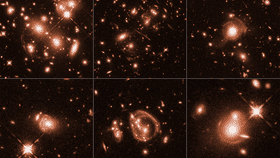


The Hubble Space Telescope has captured some of the universe's brightest infrared galaxies, which can be up to 10,000 brighter that our own Milky Way, via a spectacular phenomenon called gravitational lensing.
The light from the lensed galaxies has traveled at least 8 billion years, right out of the age of peak star formation in the universe. These galaxies are truly representative of an epoch that formed stars at an impossibly high rate. The galaxies produce 10,000 stars the mass of the Sun every year.
The results were presented at the American Astronomical Society meeting by lead researcher James Lowenthal of Smith College in Northampton, Massachusetts. Massive foreground galaxies can literally bend spacetime and magnify the light of background objects. This quirk of physics has allowed researchers to see these bright faraway galaxies better than ever before.
"We have hit the jackpot of gravitational lenses," said Lowenthal in a statement. "These ultra-luminous, massive, starburst galaxies are very rare. Gravitational lensing magnifies them so that you can see small details that otherwise are unimaginable. We can see features as small as about 100 light-years or less across. We want to understand what's powering these monsters, and gravitational lensing allows us to study them in greater detail."
Astronomers estimate that there are only about 12 of these incredibly bright objects in the visible universe. They are extreme examples of starburst galaxies and might hold clues as to how the most massive galaxies in the universe formed.
"There are so many unknowns about star and galaxy formation," Lowenthal explained. "We need to understand the extreme cases, such as these galaxies, as well as the average cases, like our Milky Way, in order to have a complete story about how galaxy and star formation happen."
These objects have been hard to study because they are incredibly dusty and don’t appear particularly bright in visible light. They are the cousins of the local universe's brightest galaxies, but researchers believe they have achieved these prodigious star formation rates in different ways. The local objects merge with each other, while in these early galaxies the gas that fuels the star formation is coming from the outside.
"The early universe was denser, so maybe gas is raining down on the galaxies, or they are fed by some sort of channel or conduit, which we have not figured out yet," Lowenthal said. "This is what theoreticians struggle with: How do you get all the gas into a galaxy fast enough to make it happen?"
The team will now analyze the data and begin to study these galaxies in earnest.