Space and Physics
 PUBLISHED


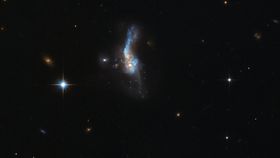


An international team of astronomers has released a detailed observational study of some of the brightest and most star-forming galaxies in the local universe, which have fascinated researchers for over 30 years.
The work, published in the Astrophysical Journal Supplement Series, focuses on luminous infrared galaxies (LIRGs). These galaxies produce hundreds of new stars every year, making it a fantastic laboratory for astronomers to explore how galaxies evolve.
These 200 objects are truly in the thick of cosmic interactions. Most of them are merging with other galaxies, with these cosmic collisions the cause of their brightness. When galaxies experience a major merging, their gas and dust are thrown around and compressed, which results in new star formation. The gas is also thrown towards the central supermassive black hole, which starts actively feeding. These two events warm up the dust and gas, and they are responsible for how bright these objects become in infrared.
Yet looking at far-infrared light has been difficult, as it's mostly blocked by the atmosphere. Space telescopes have produced better and better pictures over the last few decades, and the latest observatory, Herschel, has finally delivered the required level of detail to truly understand these objects.
"By observing at six different wavelengths in the far-infrared, we now have a complete, high-resolution picture of what these galaxies look like,” lead author Jason Chu said in a statement. “These are the highest resolution data on LIRGs for the next decade or longer. By combining data from other space missions at shorter infrared wavelengths, we now have a complete infrared picture on the importance of star formation, black hole activity, and just how much of this activity is hidden from view by dust."

The maps are released as part of the Great Observatories All-Sky LIRG Survey (GOALS) for other scientists to study.
"There are already some exciting results coming out of the Herschel dataset. For instance, we discovered that the energy output at different far-infrared wavelengths was a little different than previously thought,” co-author Dr David Sanders added. “But not only that, we can now accurately calculate several important galaxy properties, such as the average dust temperatures and dust masses in these galaxies, and more accurate star formation rates at smaller spatial scales. Plus we are confirming that most of the rapid growth phase of super-massive black holes is largely hidden from view in the optical by enormous columns of gas and dust."
The 200 GOALS galaxies will also have an impact beyond the nearby universe. Astronomers think that mergers were a lot more common in the past, so these objects can tell us a lot more about how galaxies actually came to be.