Space and Physics
 PUBLISHED


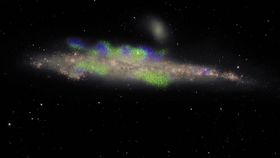


For the first time, an international team of astronomers has imaged the large-scale magnetic field present in the galactic halo around galaxy NGC 4631, also known as the "Whale Galaxy”, located 30 million light-years from us.
The discovery, reported in the journal Astronomy & Astrophysics, was possible thanks to observations by the National Science Foundation's Karl G. Jansky Very Large Array radio telescope, which allowed the team to work out the direction and strength of the field.
“This is the first time that we have clearly detected what astronomers call large-scale, coherent, magnetic fields far in the halo of a spiral galaxy, with the field lines aligned in the same direction over distances of a thousand light-years. We even see a regular pattern of this organized field changing direction,” corresponding author Dr Marita Krause, from the Max-Planck Institute for Radioastronomy, said in a statement.
In the above image, an optical view of the galaxy is superimposed with a representation of the magnetic field directions, extending into the halo above and below the disk of the galaxy. The blue region shows areas of the magnetic field that are pointed away from the observer, while the green lines are pointing more or less towards us. There are alternating blue and green regions, something never before seen in the halo of a galaxy.
Studying the magnetic field beyond the disk of a galaxy is important for our understanding of galaxy evolution both in general terms and in the more minute terms that influence the formation of solar systems like our own.
"To understand how stars like the sun and planets like Earth came to be, we must understand how galaxies, such as our Milky Way, form and evolve," explained Matthew Benacquista, a project director in NSF's Division of Astronomical Sciences. "This project is an attempt to measure galactic magnetic fields and learn how they influence the way that interstellar gases are ejected from galaxy disks and contribute to galaxy formation and evolution."
The technique used in this work will now be applied to other galaxies. The team is interested in compiling a large catalog of objects to better model what’s actually happening.