Space and Physics
 PUBLISHED
 5
5


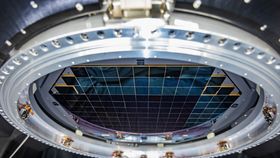


Once built, the Vera C. Rubin Telescope in Chile will provide an important new window into the universe, and crucial to that is its camera. The sensor array will make it the largest digital camera in the world, capable of taking 3,200-megapixel digital photos. In fact, it's just taken its first one. The largest single photo ever taken is a picture of a Romanesco broccoli.
If you are disappointed that it is not of the night sky, I’ll happily tell you why it was chosen. The Romanesco broccoli is organized as a fractal. Its structure is self-repeating. The distribution of its buds follows a logarithmic spiral and the number of spirals is always a Fibonacci number, which is related to the golden ratio. It's also rich in vitamin C and K.
And that’s why the broccoli was the perfect subject, (the fractal nature rather than the fact it's good for you). The team was testing the sensor array, and the detailed surface of the Romanesco is a perfect test for it.

Romanesco broccoli. LSST Camera Team/SLAC/VRO/Carnegie Institution
“Taking these images is a major accomplishment,” Aaron Roodman, the scientist responsible for the assembly and testing of the camera, said in a statement. “With the tight specifications, we really pushed the limits of what’s possible to take advantage of every square millimeter of the focal plane and maximize the science we can do with it.”
The camera will be crucial to the Legacy Survey of Space and Time (LSST) an enormous catalog of galaxies. The work will be fundamental in expanding our understanding of the universe, and will provide important insights into the mystery of dark matter and dark energy.
The Romanesco image and another released, a picture of pioneering astronomer Vera Rubin herself, shows that the technology of this spectacular instrument is truly cutting edge. The images produced by the camera are so large it will take 378 4K ultra-high-definition televisions to screen them properly. The camera can see a golf ball from 25 kilometers (15 miles) away.

All going well, the first light (first use of a telescope to take an image) from the telescope – and a picture of the heavens – is expected next year, with full operations beginning in October 2022. There have been concerns about how the pandemic might affect this timeline, but a much greater concern is the extremely negative effect mega-constellations of satellites may have on the observations.
Recent reports and studies suggest that satellites from Elon Musk’s Starlink will be extremely damaging to the telescope's pristine views due to their sheer numbers and low-Earth orbit. According to a study in March, “up to 30% of the exposures would be lost during the first and last hours of the night, and almost 50% of the twilight exposures would be contaminated.”

Vera Rubin work was key for the development of the dark matter hypothesis. LSST Camera Team/SLAC/VRO/Carnegie Institution