Humans
 PUBLISHED


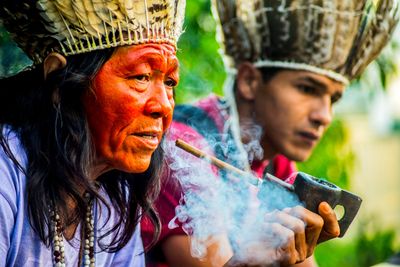


South America was the final stop on humanity’s world tour, and wasn’t settled until tens of millennia after we’d established ourselves on every other continent (apart from Antarctica, of course). Yet the region wasn’t occupied in a neat and orderly fashion, and was inhabited by three successive waves of immigrants – including one previously unknown group that was related to present-day Australasians.
The peopling of the Americas represents a puzzle for scientists, as the genetic history of the continent remains largely unexplored. To solve the riddle, the authors of a new study analyzed the genomes of 128 people living between Mexico and Argentina, and compared these to an existing database of ancient genomes from South and Central America.
Initial results confirmed existing theories based on prior archaeological and genetic research: namely, that a first wave of colonizers entered the region around 12,500 years ago before a second population arrived about 9,000 years ago. The earlier group is related to the Clovis culture that lived in North America, while the second shows a stronger genetic affinity with present-day Indigenous groups.
However, the study authors also explain that “nearly all present-day Indigenous South American[s]… show a distinct genetic affinity, showing a previously unrecognized third dispersal into South America.” This group’s genetic signal first appeared in the Caribbean around 2,500 years ago before spreading across the entire continent.
Yet the surprises don’t stop there. Amazingly, the researchers found that five present-day Indigenous Amazonian groups carry genes that are also found in Indigenous Australasians.
The study authors therefore suspect that ancient ancestors of these communities mated with an Asian lineage called the Ypykuéra, which is described as a “sister clade of present-day Australasians.” It’s thought that the Ypykuéra lived in Beringia - the ancient land-bridge that once connected Alaska to Siberia - and mingled with the ancestors of modern Amazonians about 10,000 years ago.
And while only about two percent of the genomes of these South American populations is made up of Ypykuéra ancestry, the fact that it has remained constant across 10 millennia suggests that it must have some sort of evolutionary benefit. To investigate, the researchers hunted for signals of positive selection in the genomes of these individuals, and found that several Ypykuéra-linked genes appear to have been enriched over time.
For instance, a fertility gene called LINC00871 is strongly associated with Ypykuéra ancestry and shows more evidence for positive selection than any other gene in these genomes. Other Australasia-linked genes that contribute to immunity, insulin signaling, and cancer progression also display signals of strong positive selection in modern Indigenous South Americans.
“Together, these findings indicate that several genomic regions sharing alleles with present-day Australasians were probably targets of positive selection… [and] may have shaped the health and adaptive history of Indigenous American populations.”
Put another way, the genes that certain Amazonian groups share with Indigenous Australasians may have played a crucial role in enabling their survival as they spread into previously uninhabited areas of humanity’s most recent home.
The study is published in the journal Nature.