Health and Medicine
 PUBLISHED


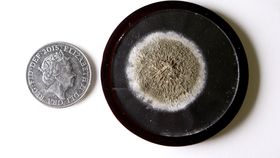

How much would you pay for a 90-year-old bit of mold? One lucky person has recently bought some for $14,617. Then again, this mold has helped save millions and millions of lives.
The mold is a sample that once belonged to Dr Alexander Fleming, the godfather of penicillin, who produced the first antibiotic. The pale-green mold is placed in a disc with a hand-signed inscription that says "the mold which makes penicillin."
Other similar samples were given to Pope Pius XII, Winston Churchill, British royalty, and numerous scientific institutions by Fleming himself. It’s therefore likely that there’s a fair number of these memorabilia discs in circulation, as he was known to readily give them away. Nevertheless, this sample still managed to sell at an auction in London on Wednesday for £11,875 ($14,617) by an anonymous buyer, the Associated Press reported.
“[He] sent these samples out to dignitaries and to people in the scientific world, almost as a kind of holy relic,” said Matthew Haley, director of books and manuscripts at the auction house Bonham’s, according to the Associated Press.
The story goes that Fleming was working on bacterial cultures of Staphylococcus in 1928. For one reason or another, a piece of blue-green mold infected the bacteria culture. He noticed there was a halo around where the mold had fallen, suggesting that it was somehow inhibiting bacterial growth. After much more work, penicillin was born and the world was graced with the blessings of antibiotics. Fleming eventually won the Nobel Prize in Medicine in 1945, alongside the two scientists who helped develop it further, Howard Florey and Ernst Chain.