Health and Medicine
 PUBLISHED


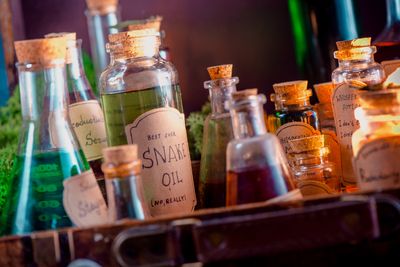


Have you heard? GenAI is just snake oil. So are supplements, and maybe peptides too. The government is filled with snake oil salesmen of all stripes, we hear; so is the King of England; so, apparently, are asset allocation specialists, whatever they are. Capitalism is snake oil. Your headphones? Snake oil.
The meaning is clear: “snake oil” is a label given to something – particularly medicine of some kind – that promises easy and effective results, but in fact provides no such thing. To sell snake oil, or be a snake oil salesperson, is to hawk such a solution, especially when you know that what you’re selling is worthless.
It’s a well-known phrase – but a weird one, right? After all, what even is snake oil? Are snakes particularly oily, or is the opposite true – does the phrase maybe originate from the idea that snake oil isn’t a real thing at all? What would snake oil, if it exists, even be used for? The questions go on and on.
And the answers – well, the answers are pretty unexpected.
The myth of the Rattlesnake King
It was the Columbian Exposition in Chicago, in 1893, and Clark Stanley was about to become famous. Dressed in stereotypical cowboy attire, with an ostentatious moustache and goatee under his wide-brimmed hat, he brandished a live rattlesnake at the crowd in front of him before slicing it open and plunging the body into boiling water.
As people watched, the fat from the snake rose to the top of the water. Stanley skimmed it off the surface of the liquid: this was his “Stanley’s Snake Oil”, and he sold it on the spot to the throng of onlookers who had been drawn in by his spectacle.
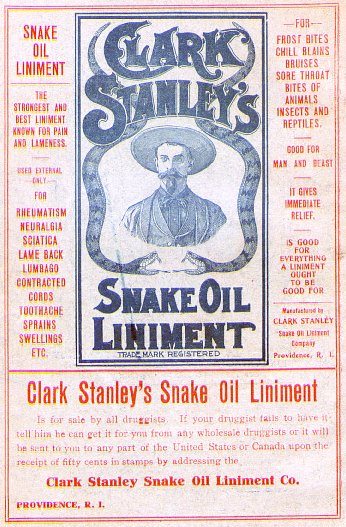
It was the era of patent medicine, and drug stores abounded with lotions and potions that promised to cure just about anything. Stanley’s snake oil was no different: it could, he claimed, treat any number of ailments, from rheumatism and neuralgia to toothache and frostbite. It was “the strongest and best liniment known for pain and lameness,” he boasted in his ads; it gave “immediate relief” and was “good for man and beast”. It was, by all accounts, a bona fide miracle cure, and Stanley was, he proclaimed, nothing less than the “Rattlesnake King”.
And, of course, it was all completely bogus.
“The crowd lapped up the hype and shelled out the money. And many claimed immediate relief from their pain,” wrote Joe Schwarcz, director of McGill University's Office for Science and Society – a department which “has the mission of separating sense from nonsense,” per his homepage – back in 2008.
“But if it offered any relief, it wasn't due to any rattlesnake oil,” he explained. “It seems the snake act was only for show, and the liniment that was actually sold had been previously prepared. And not from snakes! Chemical analysis of a surviving sample revealed a mixture of mineral oil, beef fat, turpentine, camphor and red pepper.”
The tincture wasn’t what it said – but, to be honest, it was probably better. Rattlesnake oil doesn’t, as far as we know even today, do anything to relieve pain, whether it be in your joints or your teeth – but both camphor and capsaicin do. They’re even used in pain relief and anti-inflammatory treatments today. Amazingly, Stanley’s Snake Oil wasn’t the completely useless product it would eventually give its name to.
Still, “the most effective ingredient in Stanley's snake oil was a good dose of placebo,” Schwartz wrote. It wasn’t a cure-all; it wasn’t particularly effective at all. It wasn’t even made from snakes.
But here’s the big twist: real snake oil… actually does work.
The original snake oil
Where Stanley got the idea for a snake oil liniment, we’ll probably never know for sure – he claimed at the 1893 show to have learned it from the Hopi tribe of Northeastern Arizona, but there’s no evidence that’s true, and we can hardly take Stanley’s word for it.
It’s more likely that the idea of snake oil as a curative came from further West – so much further West, in fact, that we tend to think of it as the East.
“Here's the story: In the 1800s, the US has one of its largest public works projects ever, which is the building of the Transcontinental Railroad,” explained author and journalist Aubrey Gordon in a 2021 episode of the podcast Maintenance Phase. “And it's one that was primarily powered by immigrant railroad workers, most of whom were from China.”
“These Chinese immigrant workers are coming in, doing this hard manual labor of building a railroad,” Gordon said. “They have a lot of aches and pains and to soothe [and for] that they used snake oil, which is a traditional Chinese remedy.”
Like Stanley’s tincture, this original version was made by boiling a snake in water and skimming the fat off the top; also like Stanley’s liniment, it was used as a rub for aching joints. Rather unlike Stanley and other snake oil salesmen’s versions, however, it probably really worked, and for a very important reason – it wasn’t made from rattlesnakes.
“Traditionally, the oil was extracted from the fat sack of the Erabu sea snake,” Schwarcz explained. “And that makes things interesting. As it turns out, sea snakes, like fish, are rich in omega-3 fats […] Omega-3 fats are the body's precursors to certain prostaglandins that are known to have anti-inflammatory effects. So Chinese snake oil might actually have [had] a beneficial effect.”
The rattlesnake, in contrast, has much less omega-3 in its fat profile – less than a quarter that of the Chinese water snakes that were used for Chinese snake oil. Stanley’s main and active ingredient for his snake oil was a bust – or rather, it would be, if only he was actually using it instead of mineral oil.
Now, you’ll be pleased to know that Stanley did eventually get his comeuppance. The Pure Food and Drug Act was passed in 1906, and suddenly medicines were required to, you know, do what they said they did – or at the very least, make a good-faith attempt at it. When federal investigators seized a shipment of Stanley’s liniment in 1917 and discovered it to be entirely snake-free, therefore, the jig was up: Stanley was fined $20 – about $500 today – for “falsely and fraudulently” representing his product “as a remedy for all pain.”
Stanley paid the fine, and quietly slipped into obscurity, but the idea of his “snake oil” lived on. “This huckster may not have done much for his customers' health, but he did leave us with a legacy,” Schwarcz wrote. “Thanks to him, we use the term ‘snake oil’ for ineffective remedies.”
“And,” he pointed out, “some of today's snake oils make Stanley's product look respectable.”