Health and Medicine
 PUBLISHED



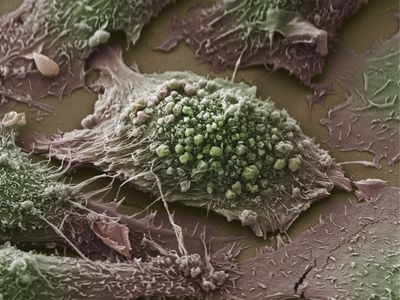


Researchers around the world are trying to understand why rates of some cancers are rising in younger generations, and newly published findings from a global research initiative suggest accelerated aging might be playing a role.
The work, produced by the PROSPECT team of the Cancer Grand Challenges Initiative, finds that younger generations are aging biologically faster than their older counterparts, and this is associated with an increased risk of developing certain cancers at a younger age.
The research also reports links between the biological age of specific organ systems and certain types of cancer. For instance, an aged immune system was found to be associated with an increased risk of early-onset lung cancer, while fat tissue aging was associated with an increased risk of early-onset colorectal cancer.
“If we can identify younger people with the highest cancer risk when they are still healthy, we can focus on prevention and early-detection strategies for the individuals who will benefit most from early interventions,” said Yin Cao at Washington University in a statement.
Biological age is essentially a measure of how much wear and tear the body has experienced compared with what you might expect at your chronological age, which is the age you are in years since your birth.
A 50-year-old who was a dedicated smoker for many years, for example, might be expected to have a higher biological age, particularly in their lungs, than a 50-year-old who had never smoked.
That said, it isn't straightforward to pin down a single value for biological age, since you can't read it off a calendar. Methods vary, but they can be based on patterns of modifications to DNA, the length of capstones called telomeres on the ends of chromosomes, levels of certain chemical markers in blood and other bodily fluids, or any combination of the above.
PhenoAge, for example, which was one of the techniques Cao's team used, is based on measures of nine blood biochemistry markers such as albumin, made by the liver, and creatinine, a waste product removed by the kidneys.
While there is some academic disagreement over the usefulness of biological age, PhenoAge along with Klemera and Doubal’s method (KDM), which the team also used, were considered the most reliable metrics in a 2025 review on the topic, based on their ability to predict mortality and track chronological age.
The researchers applied these methods to data from a cohort of 154,000 people from the UK Biobank, a long-term study that recruited half a million participants between the ages of 40 and 69 between 2006 and 2010. In the field of cancer diagnostics, a "young person" is generally considered to be anyone under the age of 55.
This was supplemented with data from around 10,000 recruits of the US National Institutes of Health’s All of Us Research Program, which started in 2018 and is open to US adults over the age of 18.
The researchers found that individuals in the UK born between 1965 and 1974 had an overall biological age that was 23 percent of one standard deviation higher compared with those born between 1950 and 1954, after accounting for chronological age.
A standard deviation is a statistical measure that, in this case, expresses how far the younger cohort was from the average biological age of the 1950s cohort when they were at the same chronological age. In other words, people in the younger birth cohort showed a modest shift toward a higher biological age than people in the older group.
The researchers observed a similar pattern in the US data. The increase was more pronounced there – participants born between 1990 and 1999 had an overall biological age that was 92 percent of one standard deviation higher compared with those born between 1965 and 1969 – but the team is also less confident of their figure because the data came from far fewer people.
The paper reports that each standard deviation increase in biological age was associated with an 8 percent higher risk of early-onset solid cancer. These are cancers that form a mass of tissue not containing liquid or cysts.
To give a sense of what that means in practice: cancer affects around 450 in every 100,000 Americans each year. This figure obviously doesn't map perfectly to the researchers' findings because it is for all cancers for all ages, but if you were to apply an 8 percent relative increase, it would translate to 36 more diagnoses per 100,000 people.
It should also be noted that older people are still far more likely to get cancer than younger people. Speaking to the BBC in April, Cancer Research UK said that one in 1,000 young people (aged between their 20s and 40s) get a cancer diagnosis each year compared with around one in 100 in their 50s to 70s.
"This study suggests that people who appear biologically older than expected for their age may have a slightly higher risk of developing certain cancers earlier in life," Jyoti Nangalia, Group Leader at the Wellcome Sanger Institute, who did not work on this research, told the UK Science Media Centre.
"Measurements of biological age are likely capturing the combined effects of many exposures such as genetics, lifestyle and environmental factors. We now need further research to understand exactly what these measurements are telling us."
“Right now, we don’t have a definitive answer to what’s driving the rise of early-onset cancers around the world," said David Scott, director of Cancer Grand Challenges in a statement. "But studies like this are helping us piece together the bigger picture, showing that cancer may be influenced not just by changes inside individual cells, but by wider changes happening across the body as a whole.”
The research is published in Nature Medicine.


 2
2