Space and Physics
 PUBLISHED
 12
12



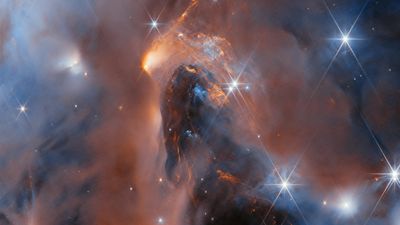


More observations from the James Webb Space Telescope (JWST) continue to challenge the distinct pictures scientists have of planet and star formation. Last year, binary objects not much bigger than Jupiter began to properly challenge the separation between the formation pathways. New research has added more fuel to the fire, having found the lightest free-floating object yet that formed like a star – and it’s only five times the mass of Jupiter.
Planets form bottom-up. They grow from small pebbles in a disk of material around stars. Stars, on the other hand, form top-down. A clump of mostly hydrogen collapses from a larger gas cloud ending in a star or a stellar-like object such as a brown dwarf. However, brown dwarfs did start making astronomers question this separation between the two processes; they are objects just a few tens of times the mass of Jupiter, but definitely from the star-formation side of things.
To investigate how to form a planet, researchers looked at a young star cluster and used JWST to find the faintest objects that formed in a star-like manner. The smallest was just 1,600 times the mass of the Earth (the Sun is 330,000 times more massive than our planet). That’s roughly five times that of Jupiter and it still has a disk of debris showing it did indeed form like a star.
“How light an object can form like a star?” Johns Hopkins Provost Ray Jayawardhana, an astrophysicist and senior author of the study, said in a statement. “It turns out the smallest free-floating objects that form like stars overlap in mass with giant exoplanets circling nearby stars.”
“Our observations confirm that nature produces planetary mass objects in at least two different ways—from the contraction of a cloud of gas and dust, the way stars form, and in disks of gas and dust around young stars, as Jupiter in our own solar system did,” Jayawardhana continued.

The presence of the disk is interesting; it could be possible for these planetary-mass objects to make their own planets from the material forming around them.
“Those tiny objects with masses comparable to giant planets may themselves be able to form their own planets,” said co-author Aleks Scholz, an astrophysicist at the University of St Andrews. “This might be a nursery of a miniature planetary system, on a scale much smaller than our solar system.”
Peculiar binary systems such as the JuMBOs – Jupiter Mass Binary Objects – were discovered last year: they make the case for the two different pathways to make a Jupiter-sized world. This work found a brown dwarf with a planetary-mass companion, again challenging ideas about their formation.
“It’s likely that such a pair formed the way binary star systems do, from a cloud fragmenting as it contracted,” said Jayawardhana. “The diversity of systems that nature has produced is remarkable and pushes us to refine our models of star and planet formation.”
The team plans to study these objects in more detail, comparing their atmospheres to brown dwarfs and gas giant planets and also looking at the possibility of planets forming in the disk of that one light object.
A paper describing the results is accepted for publication in The Astronomical Journal and available on ArXiv.