Culture and Society
 PUBLISHED
 1
1


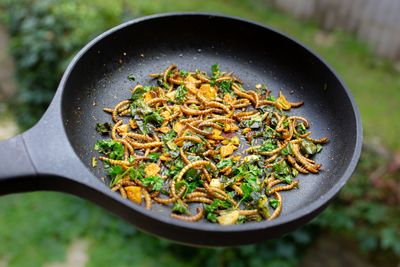


Singapore is known internationally for its food – so far, for its ability to embrace cuisines from around the world and meld them into something uniquely and deliciously its own. But the next big thing on the Singaporean menu – or, to be more accurate, the next little thing on the menu – might get the city-state a slightly different reputation.
It’s bugs.
Specifically, 20 species of insect, which the Singapore Food Agency (SFA) has approved for sale and consumption this week. “With immediate effect, SFA will allow the import of insects and insect products belonging to species that have been assessed to be of low regulatory concern,” the agency announced in a circular sent to food traders in the city-state.
“These insects and insect products can be used for human consumption or as animal feed for food-producing animals,” they said.
So which insects made the grade? The list comprises five species of cricket; three types of locust; grasshoppers; seven types of beetle larvae, including mealworms and giant rhino beetle larvae (google it if you want to lose your appetite); two types of moth larvae; silkworms, for when you’re feeling fancy; and, perhaps most surprisingly, honey bee larvae.
For proponents of insectivorous diets, it’s welcome news. “It’s really amazing to see that they have such a big list of species now that are approved for human consumption,” Skye Blackburn, an Australian entomologist and food scientist who advocates for insect consumption, told The Guardian. “It’s really showing that Singapore is a little bit more open than we thought they were going to be to edible insects”.
Eating bugs and beetles is far from a new idea. Not only is it common in more than 100 countries – with the most insect-hungry nations being Mexico, Thailand, and India – but some consider a global shift towards the practice as a potential solution to the looming climate apocalypse.
“Insects are an overlooked source of protein and a way to battle climate change,” reported the World Economic Forum in 2022. “Our consumption of animal protein is the source of greenhouses gas and climate change. [...] The consumption of insects can offset climate change in many ways.”
Of course, for many of us – Singapore included – eating insects is currently more of a nasty surprise than a novelty. But the creepy-crawlies set to enter the gastronomic world will face regulations designed to guarantee their safety for consumers: for example, they may not be “harvested from the wild”, the SFA announced, with products requiring “documentary proof that insects are farmed in premises regulated by Competent Authority.”
Other doubts about the six-legged smorgasbord may spring from the last inclusion on the list – aren’t honey bees, you know, kind of sacred at this point? But according to Blackburn, we shouldn’t worry unduly: while some cuisines do eat female bees, by far most of those used for food are males – drones.
And it seems that eating those guys is kind of doing them a favor. “They remove the drone bees from the hives because that’s where the varroa mites live,” Blackburn explained. “So that’s why the drone bees are actually used as a source of food, because it is a byproduct of the hive.”
That said, if you’re hoping to sample a delicious insect set menu, we’d probably advise avoiding the bees. Not for environmental reasons or anything. Just because, you know – bees are technically fish, not insects.