


 Space and Physics
 PUBLISHED


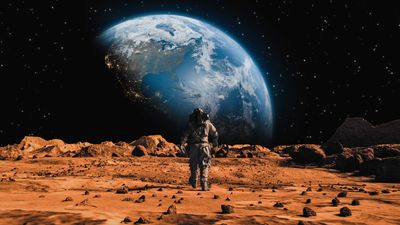


Now Artemis II is on the way to the Moon, perhaps it is time to turn our thoughts to more ambitious goals, like landing humans on Mars. Now that even SpaceX has shifted its focus to lunar missions, it is clear any mission to Mars will be put off far into the future. How far will depend on political will, how quickly technology advances, and the severity of other calls on the world’s resources. Perhaps humanity will never make it at all, either because our robots discover Martian life and we decide to leave it untainted by the bacteria we would bring, or through our own self-destruction.
However, if crewed missions to Mars are merely delayed, rather than canceled, maybe we need a date to work towards. That date would need to be more generous than JFK’s famous “Before this decade is out”, but not so distant that it is treated as irrelevant. If so, here’s why 2084 is worth considering. November 10, 2084, to be precise.
If you’re trying to think of what that might be an anniversary of, you’re on the wrong track. Instead, it’s the date of the next transit of Earth as seen from Mars, an event humanity might appreciate witnessing in person.
What Are Transits And Why Are They So Rare?
Transits are now mostly discussed in the context of finding exoplanets in other star systems alerting us to their presence when they dim their star as they pass in front of it from our perspective.
Long before we had that capacity, however, transits within the Solar System advanced our knowledge of the universe.
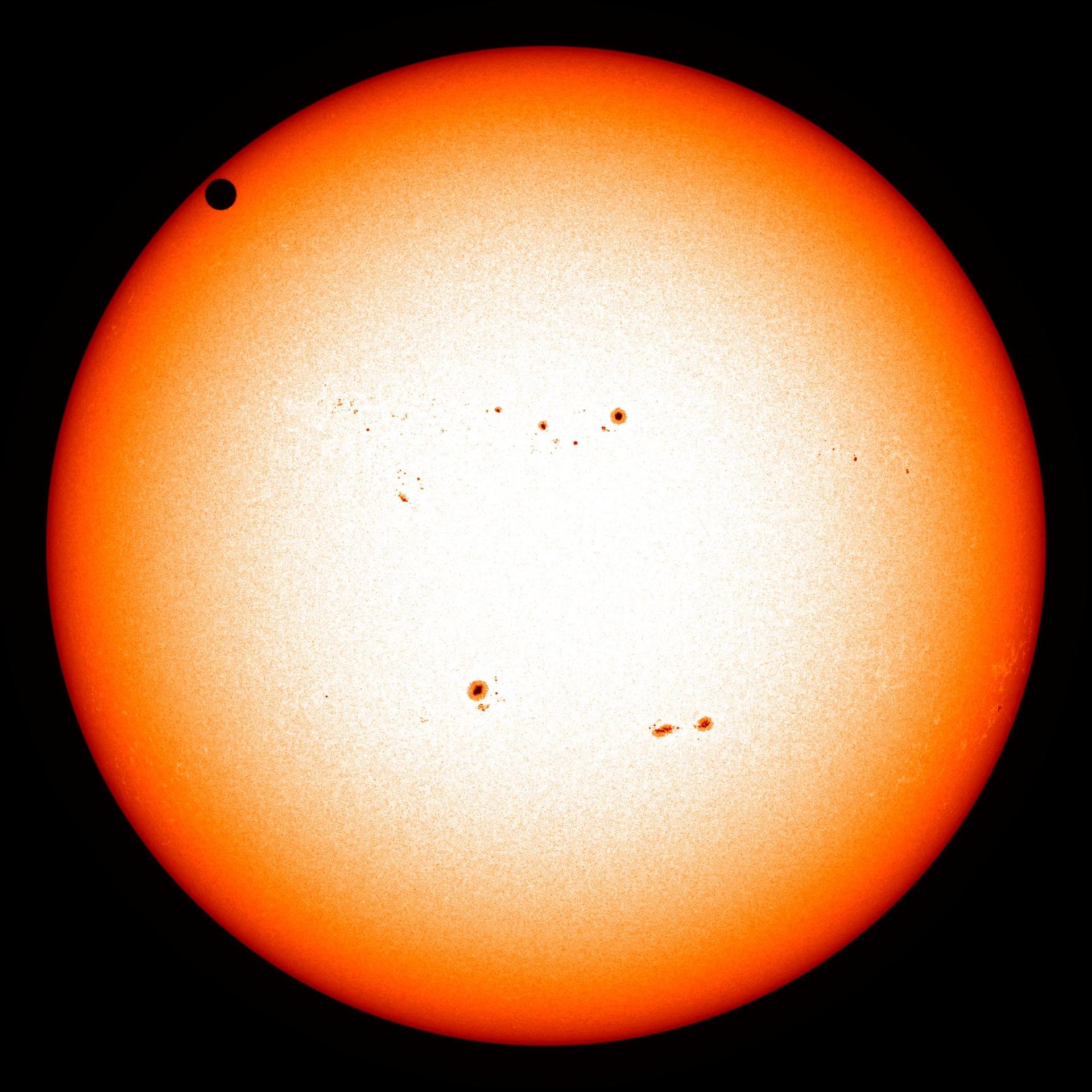
Since inner planets orbit the Sun more quickly than outer ones, they frequently pass on the inside track. If all the planets’ orbits were perfectly in a plane, every time this happened, observers on the outer planet of a pair could see the inner one pass across the face of the Sun, something known since Johannes Kepler predicted the transits of Venus and Mercury in 1631.
However, while the Solar System's planetary orbits are almost in the same plane, the alignment is not perfect. Consequently, on the vast majority of occasions, the inner planet appears to pass either north or south of the Sun. Transits only take place on rare occasions, when both planets are almost precisely passing through the planetary plane just as they align.
From Earth, we can only see transits of Mercury and Venus, but Mars gets to witness transits of Earth as well, or would if there was anyone there to see it.
Because Mercury whips around the Sun so quickly, its transits are the most common, taking place 13-14 times a century, although on a varying cycle with three to 13 years between each transit.
Transits of Venus are more famous, partly because they are so rare, happening in pairs eight years apart with alternating periods of 105 and 122 years between successive pairs. The next transits of Mercury are six and 13 years away, but anyone who missed the 2012 Transit of Venus needs to wait until 2117 to see one, unless they leave Earth.
Transits And Exploration
Transits are closely tied to the exploration, particularly through Captain Cook and the 1769 Transit of Venus. The mission to observe the Transit of Venus from Tahiti to calculate the distance between Earth and the Sun, and thus calculate the scale of the Solar System, led to the first mapping of Australia.
Kepler’s successful predictions of transits of Mercury and Venus were used to confirm his laws of planetary motion. Edmund Halley went to St Helena in 1677 to observe Mercury's transit and mapped the Southern stars while he was there.
Halley realized transits could be used to calculate the distance between the Earth and Sun, but to do this, they would need to time when they started and finished at far-flung locations, and use the differences in timing.
This required observations to be taken as far apart as possible, inspiring scientists to make expeditions for subsequent transits, frequently using the opportunity to study areas of the world previously ignored by European science.
The 1769 transit of Venus was seen as an opportunity for unprecedented precision in establishing the Solar System’s scale, but only if very precise measurements were taken from sites as distant as possible.
The transit was set to occur at night in the Americas, but Western Europe was well-suited to provide one end of a maximum baseline. For the best chance of success, observers were needed at the opposite end of the area where the transit was visible, which fell in the South Pacific. Measurements from a moving ship would be hopeless, but Tahiti, which Europeans had only recently become aware of, was almost ideally placed. Captain James Cook was sent to observe the transit.
Cook’s measurements were better than most of his contemporaries, but still lacked the precision he, as a perfectionist, had hoped for. That failure drove him harder to redeem the mission through some other success, prompting the perilous mapping of the east coast of Australia in unprecedented detail.
Transit of Earth
Cook’s mission may have hastened the tragedy that was about to be inflicted on Indigenous Australians, but it remains one of the greatest feats of navigation in human history. Consequently, there would be a certain resonance if future transits act as the spur for exploration of other worlds.
Perhaps footage of the silhouette of our “pale blue dot” passing across the face of the star that gives us life would provide the world a moment of unity and remind us what we have in common. As an added bonus, most transits of Earth also provide an opportunity to witness the Moon transiting, either leading or trailing its planet across the Sun’s face.
Certainly, future robot explorers could beam footage back to Earth, but that might not feel as real and significant as if human astronauts, perhaps even residents of an established scientific base, collected the images and described the experience.
For anyone who sees humans witnessing an Earth-transit from Mars as an inspiring goal, November 10, 2084, is the only realistic target. Those who miss an Earthly transit of Venus get another chance in eight years, but Martian transits of Earth have gaps of a century, 79, and 25 years between them. The last transit of Earth from Mars occurred in 1984, during a lull when not even explorer probes were operating. The one after 2084 will be in 2163, presumably beyond the lifespan of anyone alive today.
Although 2084 may sound ridiculously distant, a large portion of the current population of the Earth has a respectable chance of living to watch the broadcast if it occurs.
Transits of Earth should also be visible from many members of the asteroid belt, and the Cassini spacecraft even witnessed a transit of Venus from near Saturn. However, the further from the Sun the observer is, the smaller both the Sun and the planet appear without extreme magnification.
The idea that witnessing a transit of Earth from Mars might mark a significant event for humanity was floated in a short story by Arthur C. Clarke. In a prefiguring of The Martian, Clarke imagined a dying astronaut stranded on Mars watching the event.
However, Clarke was writing in 1971, while the Apollo missions were underway and optimism about planetary exploration timelines was at its peak. The astronaut in Clarke’s story was witnessing not the 2084 event, but the one that occurred in 1984. Back then, it was considered plausible that humans might set foot on the Red Planet in just 13 years, instead of taking 54 years just to pass beyond the Moon again.



 1
1