Space and Physics
 PUBLISHED
 2
2



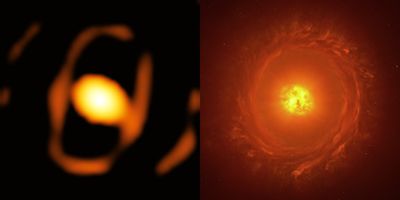


Astronomers have been studying star WOH G64 for a while. It’s a red supergiant in the galaxy next door, the Large Magellanic Cloud, and it is believed to be in the last stages before going supernova. Researchers have now broken a record by actually photographing it in detail – this had never been done before.
We see stars in other galaxies, and we can measure their properties, but to actually have a high-resolution photo of a single object 160,000 light-years away is an incredible achievement. It was possible thanks to the European Southern Observatory’s Very Large Telescope Interferometer (ESO’s VLTI).
“For the first time, we have succeeded in taking a zoomed-in image of a dying star in a galaxy outside our own Milky Way,” lead author Keiichi Ohnaka, an astrophysicist from Universidad Andrés Bello in Chile, said in a statement.
As a supergiant, the star is a lot larger than the Sun. Still, this one makes other evolved stars look like white dwarfs. It is 2,000 times larger than our little yellow Sun. In the final stages of their life, stars like WOH G64 shed their outer layers and this is seen in the image. The oval cocoon around the central star is exactly that material being blown away.
“We discovered an egg-shaped cocoon closely surrounding the star,” added Ohnaka. “We are excited because this may be related to the drastic ejection of material from the dying star before a supernova explosion.”
The shape of the cocoon surprised scientists; older and less detailed observations combined with computer models suggested a different shape. There might be a hidden companion that is causing the discrepancy.
The star has also become dimmer over the last decade, which might make future observations more difficult. It might also mean we are getting close to its explosive end.
“We have found that the star has been experiencing a significant change in the last 10 years, providing us with a rare opportunity to witness a star’s life in real time,” said co-author Gerd Weigelt, an astronomy professor at the Max Planck Institute for Radio Astronomy in Bonn, Germany.
"This star is one of the most extreme of its kind, and any drastic change may bring it closer to an explosive end," added fellow co-author Jacco van Loon, Keele Observatory Director at Keele University, UK, who has been keeping an eye on WOH G64 since the 1990s.
The study is published in the journal Astronomy & Astrophysics.