Nature
 PUBLISHED
 8
8


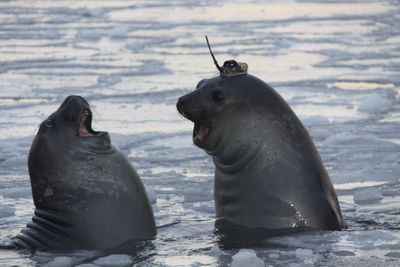


Scientists have come up with many innovative ways to explore different parts of the Earth and beyond. From enormous space telescopes, to fancy LIDAR equipment, these technologies can teach us more about the world (and universe) we live in. Now, scientists have turned to the animal kingdom and recruited the help of some marine mammals to help them learn more about unseen ocean depths and seascapes in the Antarctic.
By fixing devices atop the heads of some very helpful southern elephant seals (Mirounga leonina) and Weddell seals (Leptonychotes weddellii), researchers have been able to discover more about a hard-to-reach area in Vincennes Bay in Antarctica. The cooperative pinnipeds have even discovered a huge underground canyon that is thought to be 2 kilometers (1.3 miles) deep and has been named the Mirounga-Nuyina Canyon in honor of the seals that discovered it.
“Deep-diving seals like Weddell and elephant seals provide us with a wealth of information on the structure of the ocean floor,” said Dr Clive McMahon, lead author of the study, in a statement.
In their paper, the team states that only 23 percent of the seafloor has been mapped accurately across the globe and even less is known about the deep water around Antarctica because of its remoteness, inaccessibility, and the vast swaths of ice in the region. “Given the remote and inhospitable nature of Antarctica and the surrounding Southern Ocean, only a small part of the Antarctic continental shelf was surveyed by ships in the past, so the information available about this area is sparse,” McMahon explained.
A total of 265 Southern elephant seals and Weddell seals were captured after the molt and devices were fixed to each of the seals' heads to help collect the data. The devices record depth whenever the seals are in the water at a frequency of once every 4 seconds. They can also measure temperature, and conductivity, helping scientists understand more about the East Antarctic continental shelf and the ocean processes that are affected by climate change.

The team combined data from over 500,000 individual seal dives on the East Antarctic continental shelf and compared them to bathymetry information about the depth of the water in different locations. Mismatches between the seal data and the bathymetry information can help scientists discover more about different depths and features in different regions of the oceans.
“We found in some regions that more than 25 percent of previous estimates of the ocean depths were wrong,” said co-author Professor Mark Hindell. In some cases, the seals were diving more than 1,000 meters (over 3,281 feet) deeper than where the team thought the ocean floor was.
By comparing different data sets taken from seals, and from multi-beam sonar vessels like the RSV Nuyina, the team can learn much more about the seafloor in these different hard-to-access areas. This in turn can inform data about the melting of the ice sheets in the area and identify thinner patches.
“The observations we collect from the seals help us better understand the shape of the ocean floor, especially where there are channels for warm water to access ice shelf cavities,” McMahon explained. “This knowledge is essential for scientists trying to measure ice sheet melt rates.”
The study is published in Communications Earth & Environment.