Nature
 PUBLISHED
 1
1


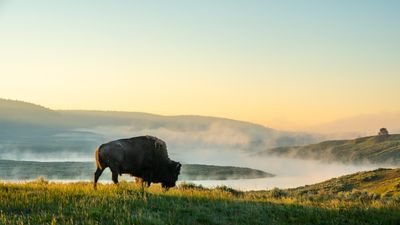


At the bottom of Buffalo Ford Lake at Yellowstone National Park, researchers have found interesting clues about the natural history of the area.
Before the 1800s CE, the American bison was thriving. Estimates of buffalo numbers on the continent vary from around 30 to 60 million at the start of the century, but that quickly changed as European colonizers reached North America.
"During the 19th century, when European American settlement was expanding into the Great Plains, bison were systematically slaughtered to the brink of extinction," the US Fish and Wildlife Service explains. "By 1889, only a few hundred wild plains bison remained in the Texas Panhandle, Colorado, Wyoming, Montana and the western Dakotas, as well as a small number in captive herds."
Not much is known about bison in the area before their numbers began to dramatically decline as European settlers took away their natural habitat for farming, and hunted them for their hides and meat. In the new study, researchers led by John Wendt of Oklahoma State University looked at the sediment of a lake in Yellowstone National Park for answers.
The study first looked at the steroids present in the dung of large herbivores, including bison, moose, elk, mule deer, and pronghorn, and compared this to the steroid profile of the lakebed sediment.
"Molecular biomarkers preserved in lake sediments are increasingly used to develop records of past organism occurrence," the team explained in their paper. "When linked with traditional paleoecological methods, analysis of molecular biomarkers can yield new insights into the roles of herbivores and other animals in long-term ecosystem dynamics."
Based on their dung alone, the team found that they could identify moose, pronghorn, and mule deer well, but elk and bison were harder to differentiate from each other. Nevertheless, they found that bison, elk, or a combination of the two were the dominant herbivores in the Buffalo Ford Lake area over the past 2,300 years.
"The Buffalo Ford Lake record provides important context for understanding ungulate occupancy of a watershed that is consistent with regional records of their management and seasonal patterns of use," the team wrote in their conclusions.
"Specifically, our results point to two millennia of continuous presence of bison and/or elk and exceptionally high impacts by these ungulates in the 20th century when hunting was banned, predators were suppressed, winter forage was supplemented with hay, and range expansions were actively discouraged."
Further study is needed to see how much changes to local ecosystems impact fecal steroid levels, but the team says that this study shows that fecal steroid analysis of lake sediment can be used to reconstruct animal presence over time.
"We developed a 2,300-year record of wild herbivore activity in northern Yellowstone National Park with fossil biomarkers found in lake sediments," the team explained in a statement. "This information is critical for understanding long-term dynamics of ecologically and culturally important herbivores such as bison and elk."
The study is published in PLOS ONE.