Health and Medicine
 PUBLISHED
 2
2





Do you struggle with motivation? Perhaps you need to file a report, but you can’t bring yourself to even open a spreadsheet. Or there’s an important conversation you need to have, but you’d rather scoop out your eyes than pick up the phone.
“Eat the frog” is a productivity strategy that suggests your day will go much better if you just get the most difficult task out of the way first. It’s a fine idea, but sometimes that can feel impossible. Being unable to begin something even when you know what needs to be done isn't uncommon. It can even be clinically significant, a symptom known to doctors as "avolition".
Avolition has been associated with conditions including depression, schizophrenia, and Parkinson’s disease. We know it happens, but what’s actually happening in the brain when we reach this mental barrier?
A new study has dived into the phenomenon by looking at macaques, a highly intelligent species of monkey. They were trained to complete two tasks. One resulted in a reward (some water), and the other resulted in a reward and booby prize (puff of air to the face).
The two conditions were indicated with a cue that gave the macaques the chance to decide if they wanted to continue. The telling detail wasn’t whether or not they decided to take part, but if they bothered beginning the task at all. It showed the macaques got on right away with the reward task, but didn’t bother starting if they could foresee it would involve getting the booby prize.
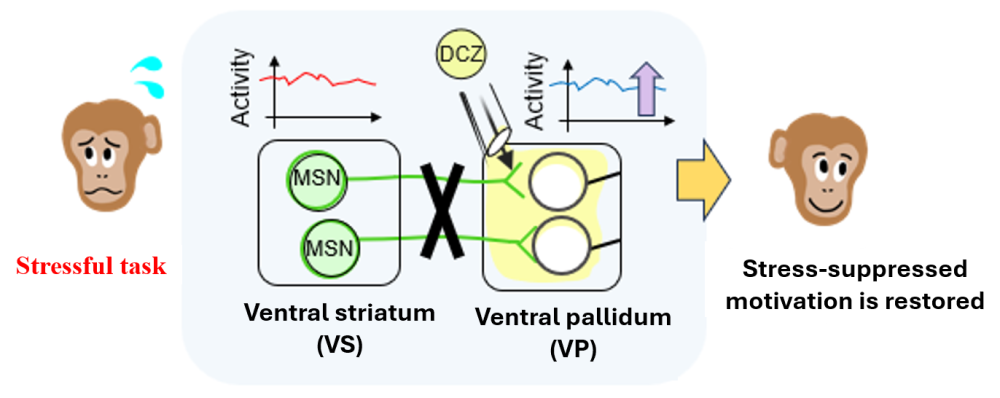
This mental brake started to disappear when the researchers temporarily weakened a connection in the macaques’ brains between two areas known to be associated with motivation: the ventral striatum (VS) and ventral pallidum (VP). This was done using chemogenetics, a targeted approach that combines genetic editing with specialized synthetic chemicals to act on highly specific cells or neurons.
The researchers also took a closer look at the neural activity that was unfolding during the two tasks and saw that activity in the VS surged during the stressful task. The VP, on the other hand, showed less activity as the macaques gradually became less interested in taking part in the tasks.
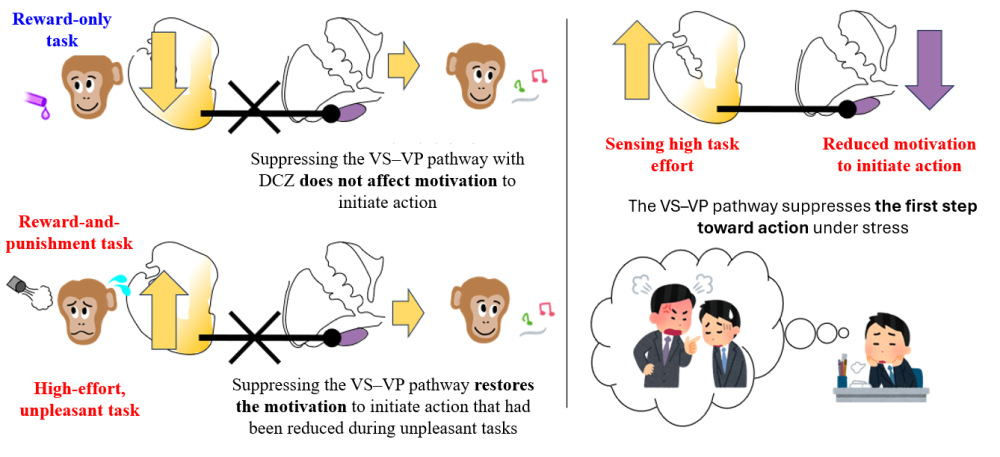
It seems that the VS to VP connection forms the "motivation brake" that decides if we just get going with stressful tasks or hold off. It’s a frustrating mental barrier when you need to do something, but it exists for a reason. As such, while this new-to-science mechanism is a promising target for medications to address clinical avolition, the researchers urge caution as we get to know more about our brain’s inbuilt motivation brake.
“Over weakening the motivation brake could lead to dangerous behavior or excessive risk-taking,” said Ken-ichi Amemori, lead author of the study, in a statement. “Careful validation and ethical discussion will be necessary to determine how and when such interventions should be used.”
The study is published in the journal Current Biology.