Space and Physics
 PUBLISHED


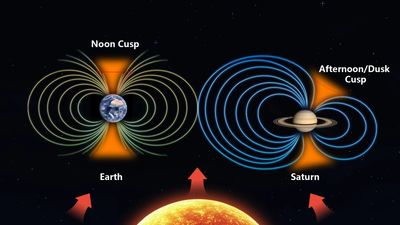


Planets with a strong magnetic field can create peculiar environments in their immediate vicinity. Earth’s magnetosphere protects us and also creates the Van Allen belts of radiation. Jupiter’s magnetosphere is the largest structure within the Solar System. Saturn, too, has an impressive magnetosphere, and new research suggests that it is quite lopsided.
The magnetic structure of the Lord of the Rings extends to be 10 times wider than the planet itself. On Earth, the magnetosphere is shaped by the internal geodynamo and by the solar wind from the Sun. From the Sun's perspective, it has two symmetric lobes: its cusp is said to be at 12 o'clock.
Saturn’s, instead, has a lobe much larger than the other, with the cusp located between one o'clock and three o'clock on an imaginary clock face. The cause for this is twofold. Saturn rotates very fast on its axis, in just 10.7 hours, helping shift the magnetosphere. On top of that, the plasma present in the Saturnian system – especially that produced by Enceladus – contributes to this lopsidedness.
“By combining Cassini observations with simulations, we found that Saturn's rapid rotation and the plasma from its moon Enceladus together shape the asymmetric global distribution of the cusps,” lead author Dr Yan Xu, from the Southern University of Science and Technology in China, said in a statement. “We hope this gives some useful reference for future exploration of Jupiter's and Saturn's space environments.”
The Cassini mission discovered that Enceladus’s south pole releases geysers that form a very wide and very faint ring. The water molecules that escape can become ionized, and it was discovered recently that this was creating waves in the magnetosphere. Now, we know that the effect is even bigger.
“The cusp is the place where the solar wind can slip directly into the magnetosphere. Knowing the location of Saturn’s cusp can help us better understand and map the whole magnetic bubble,” added co-author Professor Andrew Coates, from Mullard Space Science Laboratory at UCL.
“This study also provides critical evidence for a long-held theory – that the rapid spin of massive planets like Saturn with active moons replaces the solar wind as the dominant force shaping magnetospheres. It shows that Saturn’s magnetosphere, as well as the magnetospheres of other rapidly spinning gas giants, likely differ fundamentally from Earth’s.”
“Enceladus itself is a key driver of this environment, releasing huge amounts of water vapour that gets ionised, loading the magnetosphere with heavy plasma that is then pulled around as the planet spins.”
The Cassini-Huygens mission was a collaboration of NASA, the European Space Agency (ESA), and the Italian Space Agency. The discovery of a liquid ocean and interesting chemistry on Enceladus has prompted ESA to plan a mission back to the icy moon to study whether it might host life.
“A better understanding of Saturn’s environment is especially urgent now as plans for our return to Saturn and its moon Enceladus start to be developed. These results feed into the excitement that we are going back there. This time we will look for evidence of habitability and for potential signs of life.”
The study is published in the journal Nature Communications.