Space and Physics
 PUBLISHED
 3
3



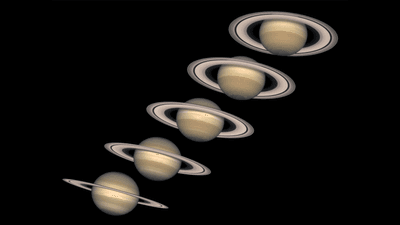


Astrophotographers and amateur astronomers this is your 18-month warning that Saturn’s rings are about to disappear from your images of the planet. Due to the tilt of the planet in its orbit around the Sun, Saturn’s iconic rings will be perfectly edge on with our line of sight, disappearing from view.
It might seem very peculiar – after all the rings are enormous. Even if we want to focus on just the brightest, most visible rings of Saturn, they extend from 70,000 to 140,000 kilometers (43,500 to 87,000 miles). In total, they cover an area equivalent to that of 30 Earths.
But while they are vast, they are extremely thin. In proportion, they are thinner than a sheet of paper. They are, in most places, less than 100 meters (300 feet) thick. And from more than 1.2 billion kilometers away (746 million miles), one kilometer is truly nothing.
In August, when Saturn was in opposition, the angle of tilt was about 9 degrees, and it will drop to zero when it gets to March 23, 2025. The edge-on view happens in intervals of 13.7 to 15.7 years, and they are due to the Earth crossing the plane of the rings. Depending on the configuration, one or three crossings can happen in rapid succession.
For example, the ring plane crossing in the 1990s took place on May 22 and August 10, 1995, and then again on February 11, 1996. But the last one was a single, on September 4, 2009. The next event following 2025 will be a triple one again: October 15, 2038, and then April 1, and July 9, 2039.
Obviously, they are not gone for good. The underside of the rings, which we have not seen for many years will come into view, as well as the planet’s Southern Pole. The maximum inclination it will reach will be in 2032, when the planet will be at 27 degrees with respect to us, truly showing off the rings.
The change in inclination is nothing new, and it has been imaged a lot over the last several decades. It is actually a good opportunity to try and catch the moons of Saturn’s system and get a truly unique view of it – at least for the next decade and a half.
[H/T: Sky at Night]