Health and Medicine
 PUBLISHED
 1
1


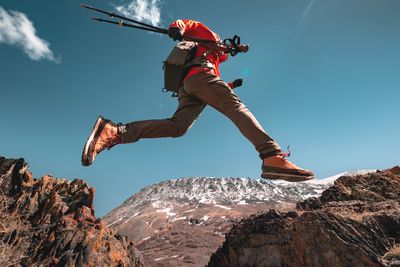


There’s apparently a new walking trend that’s inspiring people to turn the healthy, easily accessible activity into much of the same, but with a bag. Although it may sound flippant, this slightly more intense way of walking is a good, low-cost form of resistance training.
“Rucking”, as it is called, has received a lot of attention on social media over the last year or so. It's increasingly being hailed as a new way to get more out of your daily constitutional.
A casual Google search will present you with dozens of brands all looking to sell you “rucking” products, demonstrating just how widespread the trend has gotten. But what is it?
Rucking owes much of its popularity to David Goggins, a retired US Navy Seal who adapted a form of military training for civilian life.
Soldiers undergoing boot camp training have long been faced with grueling hikes and runs while carrying rucksacks filled with equipment and supplies. It’s an important form of training that prepares them for potential real-world scenarios where they have to cover long distances while carrying heavy loads. The exercise helps people develop both physical and mental resilience, which is always handy.
But while few of us will ever have to worry about the real-world applications of this type of exercise, we can still benefit from it in our everyday lives.
Put simply, rucking involves either walking or running with a rucksack on your back to add weight. You don’t really need to buy anything fancy for it; just fill a bag with as anything you have to hand to give it weight – water bottles, books, cans of food, gym dumbbells, whatever you want – and head out for a brisk walk.
That’s it. For some people, the method can be a way to enhance the health benefits of their everyday activities, while others can use it to supplement other forms of training, such as long-distance running, hiking, and so on.
It’s a great way to turn an easy exercise into resistance training for the whole body, just by adjusting the bag’s weight or the pace and length of the walk. And while it may all feel like a bit of hype, there is actual science backing up this stuff.
Research into exercise with weighted vests shows that carrying additional weight while walking demands more energy.
In addition to burning more calories, rucking typically forces people to go outside. The scientific literature is filled with the benefits of this simple act, which can improve overall mental wellbeing, especially if it is within nature. Although it isn’t clear why, being in green spaces can decrease stress and reduce anxiety, depression, and fatigue.
Weighted vests – and rucksacks by extension – can also help improve and preserve bone health by increasing bone mineral density. This has been particularly evident in knees, ankles, and hips. In addition to making everyday activities easier, improved bone mineral density can also help our balance. Rucking may well protect our bones as we age.
As with any forms of exercise, rucking has its risks, as Dr Jen Wilson, Senior Exercise and Health Practitioner, and Dr Athalie Redwood-Brown, Senior Lecturer in Performance Analysis of Sport at Nottingham Trent University, explain in a Conversation piece.
“Because the exercise combines additional weight often with uneven hiking terrain, this may also make it riskier than other workouts,” the researchers said.
Existing research has shown that soldiers who ruck (I need to make sure I spell that right) can experience back pain, shin splints, lower body stress fractures, blisters, and knee pain. This, Wilson and Redwood-Brown explained, is “probably due to the way your running and walking posture changes when additional weight is introduced.”
Hiking with weighted bags can lead to increased torso lean as well as changes to a person’s stride, resulting in increase to knee bend.
“On their own, each of these elements wouldn’t normally pose a risk. But when you add in fatigue after thousands of steps, you may be at greater risk of injury. Fortunately, these injuries are less common when walking and hiking than when running with weight – so only increase your pace when you’re ready.”
So if this sounds appealing to you, why not give rucking a try. Start gently and gradually adjust as you need. And above all, enjoy being outside.
The content of this article is not intended to be a substitute for professional medical advice, diagnosis, or treatment. Always seek the advice of qualified health providers with questions you may have regarding medical conditions.