Space and Physics
 PUBLISHED
 6
6


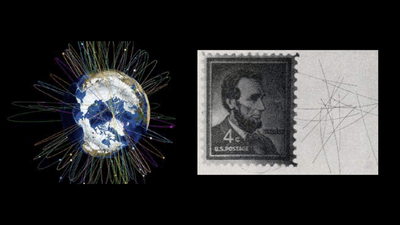


In 1961, the US military and the Massachusetts Institute of Technology (MIT) teamed up to create one of the worst collections of space debris we have fired into orbit thus far.
During the Cold War, both the US and the Soviet Union were pretty limited in how they could send long-range messages. Apart from a letter or an old-fashioned carrier pigeon, the US was left to communicate internationally by sending messages via undersea cable, or bouncing signals off our ionosphere, a charged layer of Earth's upper atmosphere.
The US wasn't too pleased with this situation. Undersea cables can be cut, whilst communication using the ionosphere was thought to be open to disruption too. The US was concerned that nuclear detonations in low-Earth orbit could disrupt radio communication, were the Soviet Union or other actors to attempt it.
One solution the US military came up with, with help from MIT scientists, was to create its own ionosphere. The idea was to launch a huge collection of copper dipoles into orbit, which would then reflect radio signals as and when needed.
The plan was controversial, with astronomers fearing that their view could be blocked by the dipoles, whilst others worried about the risk of the needles to other satellites. In order to mitigate these problems, the team designed the mission to naturally decay fairly quickly, with the needles expected to fall back to Earth on a fairly short timescale.
And so, in 1961, the US Air Force attempted to release millions of the tiny copper needles into orbit. The first attempt was a failure, with the needles not being released as planned. A new dispenser, a naphthalene gel that would quickly evaporate when released into space, was designed by the team. In 1963, the mission – dubbed Project West Ford – successfully sent 120-215 million of the needles into space.
The idea was that the needles would then slowly spread out, where they would be used to relay signals sent from Earth. But it still wouldn't be easy, nor pretty.
"Successful link operation would require high-gain (0.15° beam) antennas, high-power transmitters, and sufficient numbers of energy scattering dipoles to be present in the common volume of space where the transmit and receiving beams overlapped in the dipole belt," Donald MacLellan, a former assistant director of MIT's Lincoln Laboratory, explained of the project, dubbed Project West Ford.
"Received signals would have nasty characteristics – spread in frequency and time delay by the differential orbital velocities and positions of the dipoles dispersed in the belt."
The team was able to demonstrate that the system worked, transmitting voice, text, and data between West Ford stations at Millstone Hill in Massachusetts and Camp Parks in northern California. Unfortunately, while most of the copper needles descended into Earth's atmosphere and burned up, many of the needles clumped together and/or remain in orbit.
"Although still strongly affected by solar radiation pressure, these clumps did not decay as rapidly as the individual needles," NASA, which still tracks the known clumps, explained in a 2013 update about orbital debris.
"Today, 46 clumps remain in Earth orbit. Only nine of the clumps are currently in orbits with perigees below 2000 km."
They add that there is a moderate population of debris above this height, some of which is suspected to be clumps of the Project West Ford experiment. While not a huge problem, with many of the needles coming down without problem due to their size, the project was soon made unnecessary. Artificial ionospheres were quickly made obsolete by communications satellites, and the idea was not pursued further. Nevertheless, the Earth briefly had an artificial ionosphere that could be used for communication, and a ring of copper needles around the planet.