Space and Physics
 PUBLISHED




A private spacecraft on a pretty badass mission has sent back even more footage of the far side of the Moon, on its way to land in the Mare Crisium region of our satellite on March 2. During this latest approach, a NASA instrument placed on board the spacecraft set a new record.
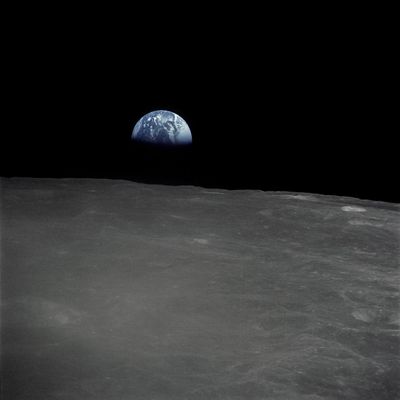
Blue Ghost, a spacecraft funded by NASA's Commercial Lunar Payload Services (CLPS) initiative and operated by Firefly Aerospace, is currently conducting a number of maneuvers to bring it into a lower orbit around the Moon. During these maneuvers, ahead of a hopefully soft landing to deliver 10 scientific and technological instruments to the lunar surface, the spacecraft captured footage of the Moon and the Earth, from the Moon's far side.
"Blue Ghost’s third and final lunar orbit maneuver is complete! Early this morning, the Firefly team performed a 16-second burn with our RCS thrusters to enter a near-circular low lunar orbit," the team said in an update on February 24. "Up next, we’ll perform a 19-second Descent Orbit Insertion at our 100-km [62-mile] perilune to begin our descent to Blue Ghost’s final destination, Mare Crisium, on March 2."
"The Firefly team completed another lunar orbit maneuver with a 3 minute, 18 second burn at 3:09 am this morning," the team said in a February 18 update. "This maneuver moved the lander from a high elliptical orbit to a much lower elliptical orbit around the Moon. Shortly after the burn, Blue Ghost captured incredible footage of the Moon’s far side, about 120 km [75 miles] above the surface."
The team adds that the newly released footage, showing the Earth rising and setting behind the Moon, was taken shortly after the second maneuver on February 18.
Footage of the approach to the Moon was also awesome.
On board the Blue Ghost Lander, NASA has placed some pretty cool equipment.
"The objectives of the mission are to investigate heat flow from the lunar interior, plume-surface interactions, crustal electric and magnetic fields. It will also take X-ray images of the Earth's magnetosphere," NASA explains. "Technology tests include regolith sampling, regolith adherence, Global Navigation Satellite System abilities, radiation tolerant computing, and dust mitigation using electrodynamic fields."
These experiments will hopefully help as humanity plans its next trip to the Moon's surface. The coolest of the experiments set to take place will come at the end of the lander's planned 14-day mission.
"On March 14, Firefly expects to capture high-definition imagery of a total eclipse when the Earth blocks the sun above the Moon’s horizon," the team explains.
"Blue Ghost will then capture the lunar sunset on March 16, providing data on how lunar dust levitates due to solar influences and creates a lunar horizon glow first documented by Eugene Cernan on Apollo 17. Following sunset, Blue Ghost will operate several hours into the lunar night."
The lunar horizon glow is thought to be caused by dust being levitated by electrostatic forces, and, while it produces a neat sight at sunset, it could be a problem for astronauts.
"In addition, the Moon has no atmosphere and is constantly bombarded by radiation from the Sun that causes the soil to become electrostatically charged," the European Space Agency explains.
"This charge can be so strong that the dust levitates above the lunar surface, making it even more likely to get inside equipment and people’s lungs."
Soon, Blue Ghost will help NASA get more data on the phenomenon. For now, they are in orbit ahead of lowering themselves toward the lunar surface, and conducting some neat experiments.
"The Lunar GNSS Receiver Experiment (LuGRE) acquired and tracked Global Navigation Satellite System (GNSS) signals for the first time in lunar orbit – a new record! This achievement, peaking at 246,000 miles [396,000 kilometers], suggests that Earth-based GNSS constellations can be used for navigation in transit to, around, and potentially on the Moon," NASA's Nilufar Ramji explains in an update.
"It also demonstrates the power of using multiple GNSS constellations together, such as GPS and Galileo, to perform navigation. After lunar landing, LuGRE will operate for 14 days and attempt to break another record – first reception of GNSS signals on the lunar surface."