Health and Medicine
 PUBLISHED
 1
1



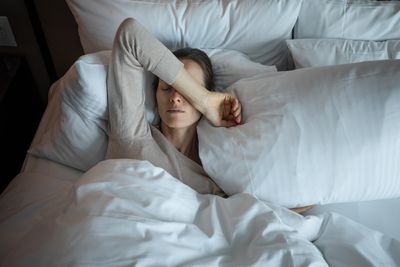


There’s nothing more annoying than not being able to sleep. Anyone who has experienced even a short period of disturbed sleep will know how frustrating it can be to just lie there willing yourself to drift off, only for your brain to have other ideas or ambient noises to get in the way. There are, of course, various ways you can combat this depending on the situation – medication, relaxation exercises, earplugs, and so on. But new research has demonstrated that one particular sleep promotor – pink noise – may not be as effective as people believe.
Noises come in colors, at least when it comes to our classification of their acoustic characteristics. For instance, white noise is an equal mix of all the different sound frequencies we can hear, which presents as a continuous hissing noise. Some people use white noise to drown out other annoying sounds.
Then there’s brown noise (also called red noise), which is made up of a sliding scale of frequencies. As the frequencies decrease, it becomes a deep, base-like rumbling which can sound similar to the steady roaring of a waterfall or the sound of heavy rainfall. Brown noise has been used to help people sleep or to concentrate on specific tasks during the day.
Finally, there’s pink noise, where energy decreases by around 3 decibels per octave as the frequency increases. In contrast to white noise, which has equal power at every individual frequency, meaning higher frequencies get emphasized (resulting in high-pitched, static-like sounds), pink noise sounds more even across octaves, producing a softer, more balanced, pleasant sound that is reminiscent of falling rain or rustling leaves.
That’s why it has become a popular background noise or a way to promote sleep by removing distractions. A casual glance on YouTube or Spotify will produce plenty of playlists dedicated to the different types of noise. In fact, the top YouTube search result for "pink noise" has been viewed 10 million times and the top five for “white noise” have been watched more than 700 million times! There are also ambient sound machines and apps that are specifically marketed as sleep aids.
But is pink Noise actually effective for achieving better sleep? Well, maybe not. According to new research, pink noise reduces restorative REM sleep and interfere with sleep recovery.
“REM sleep is important for memory consolidation, emotional regulation and brain development, so our findings suggest that playing pink noise and other types of broadband noise during sleep could be harmful—especially for children whose brains are still developing and who spend much more time in REM sleep than adults,” Mathias Basner, professor of Sleep and Chronobiology in Psychiatry at the University of Pennsylvania explained in a statement.
What’s all this noise about?
In this new study, Basner and colleagues observed 25 healthy adults – aged between 21 and 41 – in a sleep laboratory during eight-hour sleep opportunities over seven consecutive nights. The participants had reported not having had sleep disorders in the past, nor had they ever used noise to help them sleep.
Participant then slept under different conditions. Some were exposed to aircraft noise, pink noise, aircraft noise with pink noise, and aircraft noise while wearing earplugs, while a control group weren't exposed to any additional noises. After waking up (if they had indeed slept), the participants then completed tests and surveys to assess their sleep quality, alertness, and other health effects.
Sleep isn't a uniform experience. As we progress through the night, we actually cycle multiple times through periods of deep and REM sleep. The former is important for physical restoration, as well as memory consolidation, and for removing toxins from our brains, while the latter is what produces dreams. REM sleep helps us regulate our emotions and motor skills, and also helps with brain development.
As such, deep and REM sleep are both important for our everyday lives; they compliment one another, and together they guarantee that we wake up feeling more restored.
The team found that participants exposed to aircraft noise – when compared to those who were exposed to no additional sound – spent around 23 fewer minutes in “N3” – the deepest stage of deep sleep – per night. Earplugs largely managed to prevent this drop.
Pink noise on its own – at 50 decibels (which is often compared to the sound of moderate rainfall) – was associated with a nearly 19-minute decrease in REM sleep. Things got worse if the aircraft noise and pink noise were combined. This lead to significantly shorter periods of both deep sleep and REM when compared with the noise-free control group.
Participants also felt like their sleep was lighter and they woke up more frequently. They also felt like their overall sleep quality was worse when exposed to both the aircraft noise and the pink noise when compared to nights without noise – unless they used earplugs.
So could this sleep hack be quackery?
The results are a wake-up call – pardon the pun – suggesting that further research is needed into the efficacy of pink noise for promoting quality sleep. Millions of people use it and similar broadband noises during sleep every night, but the number of studies into its effects are surprisingly scarce and inconclusive.
REM sleep disruption is a common feature of conditions such as depression, anxiety and Parkinson’s disease. And as mentioned, young children, compared with adults, spend much of their sleep in the REM phase, and so may be more vulnerable. But parents will often play sound machines next to the beds of newborn children or toddlers with the hope that it will help them fall and stay asleep.
“Overall, our results caution against the use of broadband noise, especially for newborns and toddlers, and indicate that we need more research in vulnerable populations, on long-term use, on the different colors of broadband noise, and on safe broadband noise levels in relation to sleep,” Basner added.
The paper is published in Sleep.