Nature
 PUBLISHED
 2
2


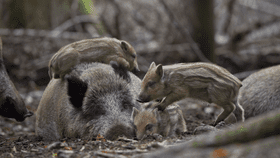


A group of wild boars recently demonstrated that sometimes teamwork really does make the dream work as they successfully freed each other from captivity in a world-first (for science) rescue attempt. Such breakout attempts have only been recorded among a handful of highly prosocial species, including rats and ants, and are considered to represent an advanced form of empathy. In a new study, not only was a female boar able to free two trapped young boars, but she carried out the rescue with remarkable efficiency, say the researchers.
A rescue attempt is defined by four key characteristics for the purposes of observational science, as researchers need to be able to identify it from other forms of social interaction. A proper rescue attempt needs:
1) A victim who is in distress 2) A rescuer who is putting themselves at risk in their attempt to free the victim 3) Some form of considerable action taken to free them, even if it’s not successful 4) No immediate benefit to the rescuer if they free the victim (they’re not just doing it for food or sex)
This scenario was created for a group of boars who were the subject of a new paper published in the journal Scientific Reports. A trap was set up among a group of wild boars (Sus scrofa) that would be triggered by individuals entering it. When the doors went down there was a juvenile and subadult inside the trap, who began exhibiting signs of distress after clocking their situation by charging at the trap’s walls and running around.

Within a few hours, a group of eight boars including an adult female was seen standing outside the cage. The female's mane was erected as she charged at logs holding the trap in place. While the photo evidence of the rescue attempt has some small gaps, it appears her efforts were able to manipulate both the front and back logs holding the trap together, eventually removing the front one entirely. At this point, the cage could be opened by the boar inside pushing against the fence and, while it took them a little while to work it out, they were both eventually freed.
“The whole rescue was fast and particular behaviours were complex and precisely targeted, suggesting profound prosocial tendencies and exceptional problem-solving capacities in wild boar,” wrote the study authors. “The rescue behaviour might have been motivated by empathy because the rescuer female exhibited piloerection, a sign of distress, indicating an empathetic emotional state matching or understanding the victims.”
This process of adopting the emotional state of your pen mates is known as “emotional contagion” and has been shown to affect pigs too, who would grow distressed at the sight of another pig in distress. It’s possible that through catching the feelings of troubled boars, the female became motivated to relieve them of their distress.
“...It seems that empathetic behaviours, in various forms, are present in Suidae and our report of rescue behaviour might represent additional evidence,” wrote the study authors. “In the case that the emotional state matching (exhibited e.g. as piloerection [mane erection]) was indeed involved as discussed above, the rescue behaviour represents the most complex form of empathy…”