Nature
 PUBLISHED


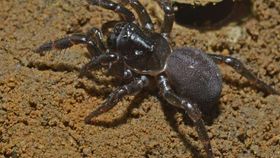


The Australian trapdoor spider belongs to a genus of trapdoor spiders that is only otherwise found in South Africa. So how did they get from Africa to the land down under millions of years ago? Researchers from the University of Adelaide say it undertook an epic voyage across the Indian Ocean on a "raft" of dirt.
Even the scientists behind this theory admit It sounds pretty crazy. This species of spider (Moggridgea rainbowi) is around the size of a coin at approximately 3.5 centimeters (1.4 inches), can only be found on Kangaroo Island off the south Australian coast, and scarcely moves more than a few meters its whole life.
However, as described in their recent study in the journal PLOS One, this appears to be one of the only viable theories.
This connection between Australia’s Kangaroo Island spiders and South African spiders was forged through comparisons of DNA sequences from six molecular markers (genes). This sequencing showed that the African and Australia trapdoor spiders belong to the same genus, but indicates a divergence between 2 and 16 million years ago, with separate populations on Kangaroo Island diverging between 1 and 6 million years ago – too late to be explained by the breakup of continents, but too early for any human involvement.
“Conventional wisdom had suggested the spiders became split from their South African relations with the separation of Africa from Gondwana around 95 million years ago,” Sophie Harrison, a University of Adelaide PhD candidate, said in a statement. “But our research showed that the divergence of M rainbowi from African Moggridgea trapdoor spiders occurred sometime between two and 16 million years ago, well after the Africa-Gondwana separation. Likewise, the timing of divergence rules out the other alternative theory for the spiders' arrival in Australia – that of being transported with humans, who arrived in Australia much later.”
The theory is that the spiders, unbeknownst to them, were transported onboard a portion of land and vegetation washed out to sea.
“The burrows they live in are quite stable and they would have been quite secure in their silk-lined tubes with their trapdoors closed – it was probably quite a safe way to travel,” added Harrison.
If true, these spiders might not be the only creature that floated across the seas to another continent. Even more incredible, scientists have previously suggested that monkeys from Africa voyaged across the Atlantic to South America by “rafting” on floating islands some 34 to 37 million years ago.