Nature
 PUBLISHED
 4
4

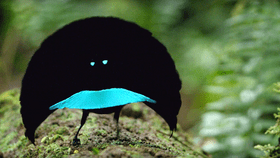


The superb bird-of-paradise (Lophorina superba) is famous for its "Vantablack" plumage, which is so extremely black that it absorbs 99.95 percent of sunlight when faced head-on (technically vanta black absorbs 99.96 percent). Now, new research published in PeerJ reveals it is not one but two different species of bird.
Wildlife experts have named the "new" species the Vogelkop Superb Bird-Of-Paradise and renamed the more prevalent species the Greater Superb Bird-of-Paradise.
"After you see what the Vogelkop form looks like and acts like in the wild, there's little room for doubt that it is a separate species," Ed Scholes, an evolutionary biologist at the Cornell University Lab of Ornithology's Birds-of-Paradise Project, said in a statement.
"The courtship dance is different. The vocalizations are different. The females look different. Even the shape of the displaying male is different."
Footage collected by Scholes and Timothy Laman, an ornithologist and wildlife photojournalist at Harvard University’s Museum of Comparative Zoology, provides the first solid evidence that the Vogelkop, which only exists in New Guinea's far-western Bird's Head (or Vogelkop) region, is an entirely different (if closely related) species to the Greater Superba, which is found throughout the rainforests of New Guinea.
A new species? Cornell Lab of Ornithology
Aside from different addresses, the two birds have a (subtly) different appearance. In both species, the males sport demonically dark feathers and almost neon turquoise markings, but when the Vogelkop displays his plumage in an attempt to woo nearby females, he creates a crescent shape with a pointed tip and the illusion of a frowning face. In contrast, the Greater Superba forms a rounded shape and the image of a smiling face.
Scholes and Lamon noticed differences in their behavior when approaching a potential mating partner. The Vogelkop does not fully open his "cape" until the female had advanced and he purposefully obscures his breast shield to emphasize his "headlight-like" eye-spot patterns.
There are also variations in the birds' mating call and dance routines. The song of the Vogelkop is a piercing whistle, the researchers say, distinct from the Greater Superba's raspy screech. Their dance routine is smoother – closer to a waltz than the Greater Superba's jive.
But it's not just the males. The females are different, too. As with many species, they tend to be plainer. Both have brown wings and a striped torso, but the head of the Vogelkop is black whereas the head of the female Greater Superba is white with a brown marking around the eyes (a lot like a Zorro mask).
The Vogelkop Superb Bird-Of-Paradise was found on Cornell's Birds-of-Paradise Project.