Nature
 PUBLISHED
 1
1


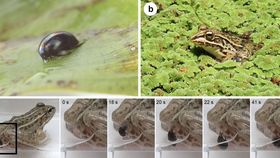


Upon finding themselves in the belly of the beast, you might think that the jig was up for a frog’s prey, but new research has revealed the astonishing escapologist skills of certain beetle. Once consumed, it can escape by hurrying through the frog’s digestive system and exiting via the vent, the place where processed food naturally leaves the frogs body. The study was published in the journal Current Biology and is the first of its kind to report the successful escape of frog prey species via the digestive system.
Videos on the internet demonstrate the lack of table etiquette of many frog species who often pummel their living prey into their mouth without so much as a cursory nibble. This means much of their prey enters their digestive system while still alive. The frog's digestive system is therefore left in charge of putting the captive insect out of its misery, but some insects have crafty defense techniques for finding their way out again.
To investigate these defenses, Shinji Sugiura, an ecologist from Kobe University, Japan, studied the passage of the aquatic beetle Regimbartia attenuata through the digestive system of the frog Pelophylax nigromaculatus. Sugiura provided R. attenuata adults to juvenile and adult P. nigromaculatus who could easily swallow the beetles still living. 93.3 percent of the swallowed beetles were excreted within six hours after being swallowed and surprisingly, all excreted beetles were alive and kicking when they made it out.
The findings indicate that R. attenuata has developed a strategy for speeding its way through the digestive system of the frog, which usually doesn’t defecate remains of eaten food until a day after swallowing them. The final obstacle for the beetles is the frog’s sphincter, which needs to be stimulated to open in order for the beetles to get out. Sugiura suggests that the beetles must stimulate the frog's gut to relax the sphincter, enabling their escape. How these tiny beetles crawl to freedom through a digestive tract and fight their way through a sphincter I can't even imagine, or maybe I just don't want to.
This defense of sped-up digestion delivering living beetles was also observed when R. attenuata was swallowed by four other frog species: Pelophylax porosus, Glandirana rugosa, Fejervarya kawamurai, and Hyla japonica. For any R. attenuata watching, Sugiura kindly made a chart of which frogs allowed for the fastest escape time.

The discovery is the first of its kind into the defense mechanisms of prey swallowed whole by frogs, and is a fantastic example of the complex adaptive behaviors of even tiny animals. So, next time you find yourself in a bind channel the spirit of R attenuata. It ain’t over till the fat frog “sings”, approximately 24 hours later...