Nature
 PUBLISHED


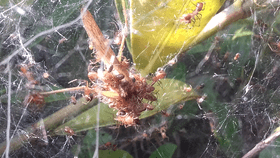


A select few spiders hunt in packs, but exactly how they synchronized their advances to take down enormous prey was something of a mystery to scientists. Now, new research believes to have unraveled the mystery, proposing a mechanism through which the spiders carry out their rhythmic approach-and-stop tactics when hunting in unison.
The predatory arachnids Anelosimus eximius are one social spider species known to attack prey in “packs”. Groups will move together to take down large insects that would be out of bounds to the solo hunter, a behavior making them the focus of a new paper published in Proceedings of the National Academy of Sciences.
To uncover the strategy behind these attacks, researchers placed a homemade vibrating artificial lure onto the web of A. eximius to trigger a hunt, observing the ensuing events.
Their observations revealed that pack hunting among these spiders isn’t led by a main aggressor, but is actually the result of all of the spiders “listening” to what’s going on elsewhere in the web and reacting accordingly.
“There is no leader to coordinate the hunt,” said corresponding author Raphaël Jeanson from the French National Centre for Scientific Research (CNRS) to IFLScience.
“Each spider integrates information via vibrations that propagate across the web. This allows the spiders to adapt efficiently and flexibly to any change that occurs during the hunt [such as the] number of spiders involved [and] variations in the intensity of the vibrations emitted by the prey struggling in the web.”

By listening to their fellow comrades, plus the intensity of the vibrations coming from their victim, these spiders can coordinate their movement to take down prey up to several hundred times larger than a single spider.
The social adaptation means they can enjoy a lavish buffet of cricket, grasshopper, or butterfly – critters no one spider could expect to kill on their own.
The researchers hope to next look into the drivers behind social behavior in arachnids. A group which, while small compared to solitary spider species, could reveal insights into stages of arachnid development.
“We want to understand what mechanisms were involved in the transitions to permanent sociality in spiders,” said Jeanson.
“Indeed, there are about 50,000 species of spiders, the vast majority of which are solitary as adults and only 20 social species. However, the vast majority (if not all) of solitary spider species are gregarious (i.e. social) during the early stages of their development, after which they disperse to live solitary.”
“What are the mechanisms that prevent spiders from dispersing and behaving socially throughout their lives? This is our question.”