Nature
 PUBLISHED
 1
1




An app created to warn surfers and swimmers when there were sharks near popular Australian beaches has enabled scientific research about interactions between humans and marine wildlife. A paper analyzing its output has expanded our knowledge of those animals' behavior in areas popular with humans, including a potentially significant change in whale behavior.
In 2017, Jason Iggleden started flying drones over the waters off Sydney's famous Bondi Beach and its neighbors and reporting the presence of sharks on what he called DroneSharkApp. What the App lacked in originality of naming it made up for in stunning visuals and its popularity quickly grew. The App currently has 359,000 followers on TikTok.
Users can choose to get notifications on anything from the sharks for which it was intended, to water quality, rips, or the chances of catching a fish. One option is for the detection of sea life; the App's website refers to “Whales, dolphins, seals, stingrays and more,” and it is this aspect that has led to a paper in the peer-reviewed journal Drones.
To get an idea of what DroneSharkApp offers, just watch this TikTok, with typical Australian commentary.
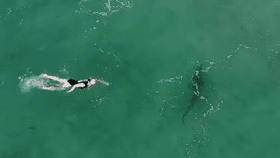
"Oh, swimmer, can you see?!" Iggleden narrates over footage of a woman obliviously front crawling over what the drone operators can clearly see is a shark. "Surely... oh yep, she did now! She's like, 'I'm out there!'" he says as she picks up speed towards the beach.
Watch the whole thing, we promise you it is worth it.
Dr Vanessa Pirotta of Macquarie University saw an opportunity for more than just a live nature documentary, however. She and her co-authors studied 678 videos posted from the App to Instagram over 432 days of observation.
From these the authors were able to find 94 feeding events from major marine predators and 101 interactions between sharks and humans. Fortunately, there was no overlap in these; that is no cases of sharks feeding on humans. The threat of shark attack may loom large in the imagination of those living close to tempting sea waters, but actual bites are rare, and in Australia, fatal ones are rarer than death by cow.
DroneSharkApp was also used to reveal many examples of humpback and dwarf minke whales traveling north with their calves, confirming Pirotta's previous observations. This is perhaps the most significant aspect of the paper. Traditionally these whales calve off North Queensland. The fact that they are now sometimes giving birth thousands of kilometers to the south indicates something major has changed in the marine environment.
As the paper notes, drones are increasingly popular with marine biologists, being used to study species distribution, density of jellyfish and humpback whales' upper respiratory tract infections, among many other topics. However, recording the most valuable data can take time, and scientists do not always have enough of their own to get what they need. When those flying the drones for other reasons filter down their footage and offer it to the world for free the results can be a boon to science.
The authors tracked the number of sitings of sharks, rays, fur seals, dolphins and whales by month. Although some, such as the migratory whales, follow well understood patterns, others, such as the near disappearance of dolphins in summer and early autumn, could drive further research on where these animals go.
Fur seals (58) and dolphins (33) accounted for the bulk of the feeding events witnessed, including the spectacular footage of each targeting large fish schools known as bait balls. The authors describe these behaviors as “traditionally ...very difficult to reliably observe in the wild.” There was also one case of a humpback lunge feeding. In keeping with the App's original aim, two white shark feeding events were recorded.
Iggleden keeps his drones more than 100 meters (330 feet) from any animals that might be disturbed, in accordance with regulations in his state. More extensive versions of the videos used in the study are available to those who pay for the App.