Nature
 PUBLISHED


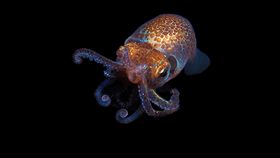


Symbiosis has brought together some of the most iconic duos in the natural world (where would Nemo be without the anemone?). These serendipitous relationships come about as two separate entities glean a benefit from their association with one another. In the case of the Hawaiian bobtail squid (Euprymna scolopes), this was between itself and a type of bacteria that colonize its light organs within hours of the squid hatching. Here, they put on one hell of a light show on behalf of the young squid who benefits from counterillumination: the use of light to mask an animal’s silhouette or shadow from its environment.
The species has long been studied as a shining (in the most literal sense of the word) example of mutually beneficial symbiosis. Despite all this insightful research, a new paper published in the journal mBio has made a pivotal discovery as to what triggers the bacteria to colonize these squid, "It's exciting that there are still new things to discover, even in such a well-studied system," said corresponding author Laura Sanchez, associate professor of chemistry and biochemistry at UC Santa Cruz.
When bobtail squid hatch, they are rust-colored and completely without sparkle. A few hours later, their light organ is flooded by Vibrio fischeri, a type of bacteria that is pretty sparse in the ocean environment and yet somehow finds itself aggregating inside the body of a thumb-sized squid.
To find out why V fischeri was drawn to these diddy cephalopods - and to understand why some strains are better at colonizing than others - this new research investigated if chemical signals could be the key. Using imaging mass spectrometry, Sanchez and colleagues were able to directly visualize the spatial distribution of chemicals within the squid. The technique tops others used to map chemicals in that it allows you to get a lay of the land within a sample even when you’re not entirely sure what you’re looking for, as molecules don’t need to be labeled for them to show up.
Pleasingly, the shot in the dark shone a lot of light on a small but pivotal molecule in the samples. From the diketopiperazine (DKP) family, a group of cyclic dipeptides, the particular dipeptide (DKP--cyclo(D-histidyl-L-proline), or cHP-3) was found inside the squids’ colonized light organs. Further tests showed that there was variation within V fischeri too, as it was found in greater concentrations in some strains compared to others. To get one last look at the dipeptide's effect on bioluminescence, they supplemented cultures of V fischeri with cHP-3 and consequently saw a spike in luminosity concurrent with the concentration increase of cHP-3.
"We know that it is produced during the first few hours of colonization when the symbiosis gets established, and we also know that it influences bacterial luminescence, and bioluminescence and colonization are tied together," Sanchez concluded, though the exact role and mechanism behind the association - for now - remains unclear.
"We're working on that now. We don't know the mechanisms involved, but there's a lot more going on than we thought there was. The next steps for us are to find the gene cluster that produces it, and to find how widely used it is."

 1
1