Nature
 PUBLISHED




Towards the end of the last ice age, somewhere between 35 and 90 percent of the large-bodied animals outside Africa disappeared. Human hunting provides an obvious suspect, but firm evidence our ancestors ate these great animals out of existence has been scarce. A new discovery both proves giant ground sloths were on the menu and shifts the likely dates for when this happened.
Today, most of the really large wild animals are confined to Africa, but it's not that long ago that every continent (aside from Antarctica) had a rich share of so-called megafauna. One of the longest-running and most-heated debates in all of science concerns how many of these species died out because of humans – whether through direct hunting or changing their environments – and how many were done in by climate change.
In the absence of direct evidence that most of these species were killed by humans, the timing of extinctions has been key to the debate. The question has been particularly difficult to resolve for North and South American species, however, because humans arrived on the continents as the world was leaving the last ice age.
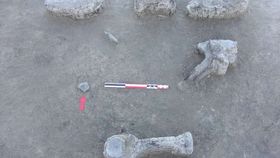
Campo Laborde in north-east Argentina contains many bones of extinct megafauna, including a giant ground sloth that roamed South America for millions of years. It also has a lot of quartz and chert tools. Dr Gustavo Politis of the National University of the Center of the Buenos Aires Province found what appear to be cut marks on one of the sloth ribs. Moreover, he reports in Science Advances, the locations of the tools and sloth bones are too closely correlated to be a coincidence. These blades were used to kill the sloth and butcher its carcass, the first case of a sloth clearly killed by humans. Some tools were also made from sloth bones. Most bones from other species at the site appear to be from animals that died of natural causes.

The highlighted cut marks on this giant sloth bone prove it was butchered by humans towards the end of the last ice age. Politis et al/Science Advances
Having confirmed humans did indeed hunt giant ground sloths, Politis turned to the bones' ages.
Previous studies of the most recent sloth bones in Argentina placed them in the Holocene, the warm period after the last ice age. Politis and co-authors concluded the age of the bones was underestimated because of the degradation of the collagen under the swampy conditions.
Using alternative dating methods, the authors conclude that the unfortunate sloth died in the twilight of the last ice age, rather than a warmer world. Moreover, they concur with recent reassessments of other megafauna dates found in the Pampas region of South America, concluding these also predate the Holocene. This suggests the sloth extinction on the Pampas occurred at a similar time to other parts of South America, within 2,000 years of humans arrival, pointing the finger of blame directly back at us.