Nature
 PUBLISHED



A new microorganism discovered deep in the Arctic Ocean may be the missing link between single-celled organisms like bacteria and more complex cellular life forms, ranging from conifers to cockroaches to cats. The findings, described in Nature this week, may help explain how elaborate cellular life originated.
All living organisms fit into just one of two groups: prokaryotes and eukaryotes. They split about two billion years ago. The smaller prokaryotes -- comprised of bacteria and a whole other domain of life called archaea -- are made of simple, mostly single cells with no nuclei. The larger, more complex eukaryotes have multiple cells, each with a membrane-enclosed nucleus, organelles, and some kind of internal organization. One major exception to the multi-cellular rule are the single-celled protists, like amoebas.
We’re more closely related to archaea than bacteria, though exactly how eukaryotic cells evolved from prokaryotic cells still puzzles scientists today. Most agree that our mitochondria and plants’ chloroplasts descended from free-living prokaryotes that started living within other cells, Science explains. But if we only had something to bridge the gap between prokaryotes and us...
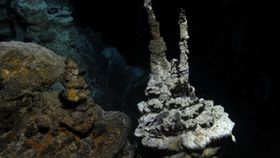
A team led by Uppsala University’s Lionel Guy and Thijs Ettema surveyed microbial diversity in deep marine sediments near hydrothermal vents along the Arctic Mid-Ocean Ridge thousands of meters below the surface. They didn’t actually see the cells, but based on DNA extracted from a 10-gram sediment sample, the team identified a new type of archaea that they say is the closest prokaryote to the eukaryote state ever discovered. They named it Lokiarchaeota, or Loki for short, after Loki's Castle, a hostile volcanic system about 15 kilometers away from where it was found.
 "By studying its genome, we found that Loki represents an intermediate form in-between the simple cells of microbes, and the complex cell types of eukaryotes," Ettema says in a news release. And as New Scientist describes it, they're our closest simple-celled relatives from just before eukaryotes split from prokaryotes.
Importantly, Loki has genes that have only been found in eukaryotes, "suggesting that cellular complexity emerged in an early stage in the evolution of eukaryotes," according to study author Anja Spang of Uppsala. For example, they found genes for a protein similar to actin, which helps make up cytoskeleton, a support system for structure and movement in eukaryotic cells. These genetic features, the team writes, may have provided a starter kit to support the increasing complexity of the first ancestral eukaryotes. However, Loki seems to lack some signature features of eukaryotes, Science reports, including a nucleus and mitochondria.
Lots of unknown microbes are still awaiting discovery in these sorts of extreme environments. Researchers call them microbial dark matter.
Images: Centre for Geobiology (University of Bergen, Norway) by R.B. Pedersen

 1
1