Nature
 PUBLISHED




Collections of bacteria known as biofilms can store memories of exposure to light, providing intriguing parallels to the way neurons process memories in our brains. This doesn't mean you need to be nice to bacteria lest they harbor a grudge, but it may prove useful for neuroscience research and making biological computers.
Recent discoveries by Professor Gürol Süel of the University of California San Diego have helped promote renewed respect for bacteria, demonstrating they can communicate with each other in colonies using ion channels and even support each to share resources. Süel and others have also demonstrated bacteria can remember certain events, changing their response to circumstances based on what they have experienced previously.
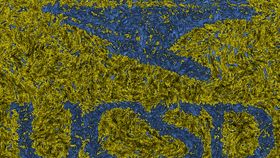
Süel brings these two discoveries together in Cell Systems. Blue light has been found to alter the flux through cells' ion channels, so Süel's team spread Bacillus subtilis on a growth medium and illuminated them for five seconds with a fluorescent lamp. Using a mask of the University's logo, some of the bacteria were protected from the light, while others were fully exposed. Even hours later, the responses of the bacteria varied depending on whether they were shaded or not, with the exposed bacteria having more potential to transport potassium through their membranes.
"When we perturbed these bacteria with light they remembered and responded differently from that point on," Süel said in a statement.
When potassium availability was cycled on and off, the light-exposed bacteria produced the exact opposite response to those that had been shaded, closing their potassium channels when their counterparts were opening them. Feeding the bacteria glutamine restored them to their usual state. The researchers hope to put this to use, turning bacteria into a model for neurons.
“For the first time we can directly visualize which cells have the memory,” Süel added. “That's something we can't visualize in the human brain."
With suitable masks, bacteria could be turned into a circuit board, with some light-primed and others not, turning bacterial communities into a sort of computer. The team also found longer light exposures produced greater changes to membrane potential, suggesting outcomes could be more nuanced than simply whether a bacteria was primed or not. If varying intensity or wavelength of light produce different sorts of priming, then even more sophisticated devices may be possible.
"Bacteria are the dominant form of life on this planet," Süel said. "Being able to write memory into a bacterial system and do it in a complex way is one of the first requirements for being able to do computations using bacterial communities."
When some bacteria were exposed to bright light and others were shielded they subsequently responded in opposite ways to cycled potassium availability