Nature
 PUBLISHED
 2
2


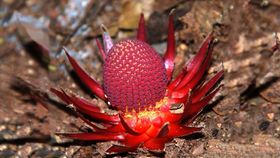


This fierce red plant isn’t your typical forest shrub. It’s actually a rare, scaled, parasitic plant that wraps nutrient-sucking ropes around neighboring plant roots to steal the food they worked so hard for. If you haven't tuned in yet, welcome to 2020.
Langsdorffia, or the "vampire plant," lives in forests and savannas in Central and South America, Madagascar, and Papa New Guinea, and produces bright red flowers that mark their feasting ground. The four distinct Langsdorffia species currently known are types of holoparasitic plants, meaning they don’t photosynthesize themselves. Instead, they use underground tentacle-like suckers to grab nutrients from the roots of many different plant species, relying solely on their hosts for survival.
A lack of chlorophyll results in a blood-red flower that looks like something hailing from the depths of the ocean, not the forest floor. Although in some good news, while they may slowly suck the nutrients from other plants, they represent no harm to humans.

Despite their recognizable flower colors and characteristic shape, little is known about these parasitic plants. It would seem likely a bloom of Langsdorffia would accompany the death of other plants in the area, but the effect of these plants on the surrounding ecosystem is yet to be discovered. This is in part due to how rare Langsdorffia is, only being found in remote locations and only blooming in dry conditions.
Dr Chris Thorogood from the Department of Plant Sciences at Oxford University Botanic Garden believes that parasitic plants should be included in local plant collections to broaden our understanding of their ecology.
"Langsdorffia, like other parasitic plants, is poorly represented in botanic garden collections, and should be a candidate for further research and conservation focus," Thorogood and colleague Jean Carlos Santos write in a Plants, People, Planet.

To aid pollination, Langsdorffia secrete a sweet nectar to attract various birds and insects to feast on their "nubbins" during the arid conditions of the dry season. Interestingly, plants in the species L. hypogea are distinctly male or female, and secrete the nectar in different ways – males secrete nectar from between each nubbin, whilst females spread it from the skirt.
Although rare, these little forest Draculas are stunning displays of plant diversity. Parasitic plants remain elusive and tough to study, but conservation of Langsdorffia is underway in the hopes of future cultivation. Protecting the forests they reside in is incredibly important.